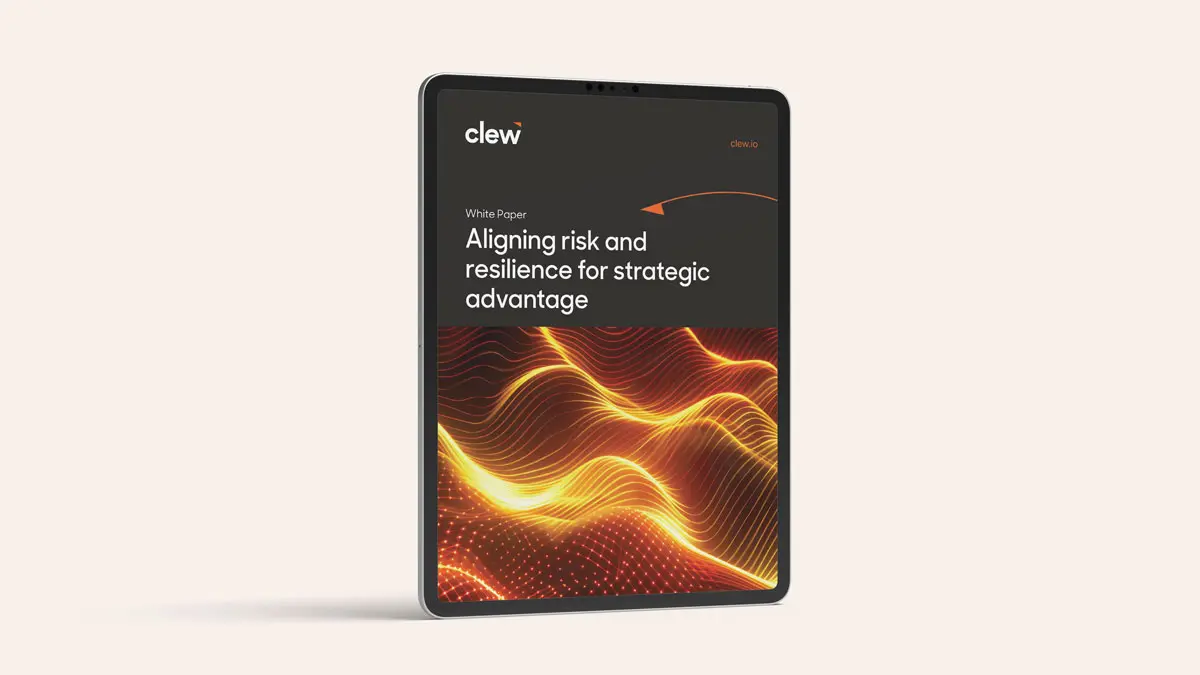
Why Integrated Risk and Resilience Management Is the New Imperative for Enterprise Leaders
Most organisations treat risk management and resilience as two separate disciplines. That separation is costing them more than they realise.
When your risk team and resilience function operate in silos, your board receives two conflicting narratives. Your operational managers are asked for the same information twice. And in a crisis, when every minute counts, your teams are debating terminology instead of acting. The cost of disconnection is real, and it compounds over time.
This free white paper from Clew explores why the integration of risk and resilience is no longer optional for enterprise leaders, and what it takes to get there.
What You Will Learn
The True Cost of Running Risk and Resilience in Silos
Fragmented Reporting, Duplicated Effort, and Slower Crisis Response
In today’s business environment, disruption is not an exception. Cyberattacks, supply chain failures, regulatory breaches, and reputational crises do not respect organisational boundaries. They test your foresight and your recovery capability simultaneously. Organisations that have yet to align these two functions are carrying a structural vulnerability at the heart of their operations.
Clew’s white paper, Aligning Risk and Resilience for Strategic Advantage, gives senior risk, resilience, and assurance professionals a clear framework for understanding where the gaps exist and how to close them.
Key Topics Covered in This White Paper
From Historical Divergence to Modern Integration
- A breakdown of how risk management and resilience evolved as separate disciplines, and why that divergence now creates dangerous blind spots
- A frank examination of the structural, cultural, and governance barriers that prevent integration, and how leading organisations are overcoming them
- A staged framework that helps you identify where your organisation sits today, from siloed functions exchanging occasional data, to fully integrated enterprise capability
- Practical insight into how integrated reporting changes the quality of board-level decision-making
- Guidance on the role of technology in sustaining integration across risk registers, business impact analyses, and continuity plans
- A forward-looking perspective on the cultural shift required to make integration part of your organisation’s DNA
Who This White Paper Is For
Risk, Resilience, and Assurance Leaders Navigating a More Complex Operating Environment
This paper is written for Chief Risk Officers, Head of Resilience, Business Continuity Managers, and senior governance and assurance leaders who are responsible for protecting enterprise performance in an increasingly volatile operating environment. It is also essential reading for boards and executives who want to understand whether the information they receive reflects the full picture of their organisation’s exposure and recovery capacity.
Why It Matters Now
Regulators, Investors, and Boards Are Raising the Bar on Resilience
Building Competitive Advantage Through Connected Risk and Resilience Capability
Regulators are raising expectations. Investors are scrutinising resilience credentials. Customers and partners want confidence that the organisations they work with can absorb disruption without losing pace. The enterprises that will build lasting competitive advantage are those that integrate risk and resilience into a single, coherent capability, not those with the most sophisticated frameworks sitting in separate drawers.
The white paper draws on Clew’s experience working with organisations across the UK, Australia, and Canada to build connected, intelligence-led risk and resilience programmes that move at the speed of the business.
Download your free copy today and take the first step toward turning disruption into a proving ground for competitive strength.