Your Risk Frameworks Are Only as Strong as the Culture Behind Them
Most organisations already have the registers, the dashboards, the policies, and the reports. What they are missing is the one thing no framework can manufacture on its own: a culture where risk ownership is genuinely shared across the enterprise.
When culture is weak, assurance becomes theatre. Dashboards glow green, reports circulate, and frameworks appear sound, while beneath the surface, warning signs are ignored, accountability is diluted, and blind spots quietly widen. The result is an organisation that looks compliant but is dangerously exposed.
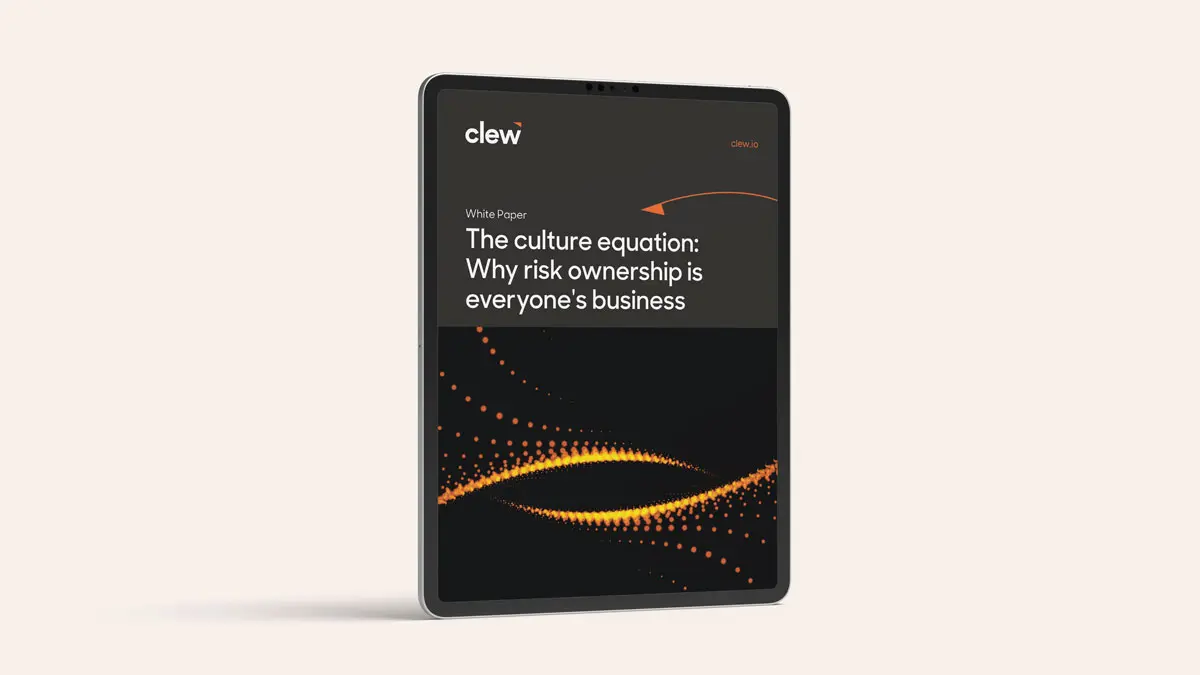
This free white paper from Clew makes the case for treating culture as deliberately as you treat strategy, finance, or operations. Because when culture supports ownership, risk management stops being a box-ticking exercise and starts becoming a genuine performance enabler.
“Culture decides whether leaders hear the truth or a sanitised version. And ultimately, it decides whether risks are managed, ignored, or quietly rewarded.”
What This White Paper Covers
Why Culture Is the Operating System of Your Risk Programme
What Happens When the Structure Is Intact but the Truth Has Been Hollowed Out
The white paper opens by examining why frameworks alone are not enough. Using the risk register as a practical example, it shows how staff behaviour, leadership signals, and board expectations determine whether that register reflects reality or simply a story everyone has agreed to tell.
The Three Levers That Shift Risk Culture
1. Tackling Bias: Exposing the Blind Spots That Derail Sound Judgement
Optimism bias, groupthink, and the normalisation of deviance are not edge cases. They appear in post-incident reviews time and again. The paper sets out practical tools including independent challenge, red-teaming, and pre-mortems that constrain these distortions before they become costly.
2. Accountability: Making Risk Ownership a Natural Extension of Performance
True accountability sits with those who own objectives, not with the compliance team or internal audit. This section explains the three conditions required to make that shift stick: clarity of role, connection to organisational outcomes, and meaningful consequences for both good practice and negligence.
3. Behaviour: Turning Culture from a Slogan into a Daily Reality
Culture is what people do when no one is watching. The paper explores how incentive structures, storytelling about near misses, and peer reinforcement can embed risk ownership across the business, not just at the top.
The Four Barriers That Derail Even the Best-Intentioned Programmes
Why Good Intentions Are Not Enough Without Structural Change
Silos, Fear of Blame, Short-Termism, and Cultural Drift
Progress often collides with ingrained habits, political dynamics, and day-to-day delivery pressure. The white paper names the four barriers that appear most consistently across organisations and gives practical guidance on how to overcome each one, including how to build no-blame reporting channels, how to align incentives to long-term resilience outcomes, and how to run cultural diagnostics that catch drift before it becomes a crisis.
What Distributed Risk Ownership Actually Looks Like in Practice
From Compliance Programme to Cultural DNA
The Tipping Point Where Risk Stops Being Something You Do and Becomes How You Operate
The ultimate goal described in this paper is distributed ownership, where risk is not the job of a single department but the shared mindset of the entire enterprise. When that tipping point is reached, three things happen: resilience strengthens because early warning signs surface faster, trust grows between boards and frontline teams, and performance improves because risk becomes a lens that sharpens decisions rather than a drag on them.
Who Should Read This White Paper
For Leaders Who Are Serious About Making Risk Culture a Strategic Priority
This paper is written for Chief Risk Officers, Heads of Compliance, Internal Audit leaders, Business Continuity Managers, and any executive who suspects their organisation’s risk programme looks better on paper than it performs under pressure. It is equally valuable for boards who want to ask sharper questions about whether the culture beneath their governance frameworks is genuinely supporting resilience.
The Equation Is Simple. The Work Is Not. Start Here.
Frameworks and technology give structure. Culture gives truth. Without ownership, even the most sophisticated systems are hollow. With it, risk becomes a living capability that shapes how people decide, act, and deliver under pressure.
Download your free copy of The Culture Equation today and take the first step toward building a risk programme that the whole organisation actually believes in.