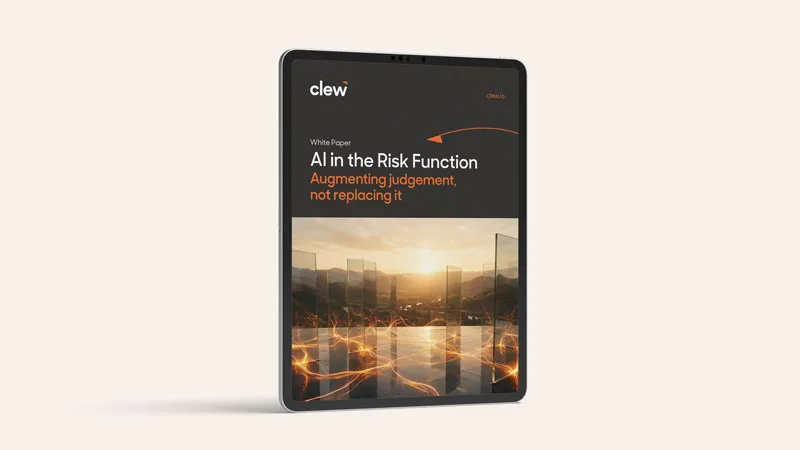
Artificial intelligence is already inside the organisations that risk teams support. Procurement groups draft scenario narratives with it, operations teams apply machine learning to predict equipment failure, and legal teams run AI tools across contracts. Somewhere in most businesses, someone has already entered a risk register into a language model and asked it to suggest controls. For anyone responsible for AI in the risk function, the question is no longer whether to engage. The pace of adoption has settled that. What remains is whether that engagement is deliberate, governed, and shaped by the people who understand risk best.
What AI actually changes for risk teams
Much of the work that fills a risk manager’s week is administrative. Updating registers, chasing control owners for evidence, consolidating workshop notes into structured formats, and reformatting reporting for different audiences all crowd out the analysis and forward thinking that make risk practice valuable. This is the area where the evidence of value is strongest. The white paper examines where AI already makes a measurable difference, from drafting initial control descriptions to summarising long incident reports and turning raw interview notes into a coherent narrative, and what happens to a function’s capacity once that friction is removed.
Seeing across the data, not just within it
Meaningful risk data lives in different systems, sits with different owners, and reports on different cycles. Synthesising that picture by hand is slow and inconsistent. The paper looks at how pattern recognition can surface clusters of control failures that share a root cause, incident categories trending toward the threshold for escalation, and correlations that only appear when you look across a large volume of records. It is equally candid about the single condition that decides whether any of this works: the quality and discipline of the data underneath it.
Two assessors, two answers, one register
Ask two risk owners to assess similar risks and you will often get two ratings, two vocabularies, and two thresholds for what warrants escalation. That inconsistency weakens the comparability that makes aggregate reporting meaningful. The white paper explores how structured prompting and validation can reduce this variation at scale, without removing the human judgement that sound assessment depends on.
The risks that come with AI in the risk function
Adoption is not free of exposure. The paper is direct about the capabilities that quietly weaken when a tool produces the first draft every time, the accountability gaps that open when outputs look authoritative, and the way fluent, confident answers can hide genuine uncertainty. It also makes the case that the risk function is unusually well placed to govern these exposures, because accountability is already its founding principle, provided it acts before AI use becomes too embedded to revisit.
What AI still cannot do
AI is trained on patterns in data. It is not trained on the history of a particular supplier relationship, the dynamics of a leadership team, or the reasons the absence of a signal can matter more than its presence. The white paper draws a clear line between what a model can process and what only context, judgement, and conversation can interpret, and why the people closest to an organisation remain the ones best placed to read what the data means.
Who This White Paper Is For
Chief risk officers and heads of risk will find a practical view of where to start and what to protect as AI enters their function. Risk managers and assessors gain a clearer sense of which tasks to hand over and which to keep. Boards and executive leaders responsible for governance will take away the specific questions worth answering in writing, before AI use becomes contentious in a real case.
The patterns being set now will be difficult to reverse, which is why a considered approach to AI in the risk function matters more than a fast one. This white paper offers a clear and honest guide to what changes, what does not, and the practical steps any risk team can take today. Download the white paper to read the full analysis.