Alex Bentley is CEO at Clew, the risk and assurance platform helping organisations connect risk to strategy and business performance. With over 10 years of experience in enterprise SaaS, he has worked with risk and governance functions across the private and public sectors and writes on the future of risk management and what it takes to build a risk function that influences business outcomes.
Why the next era of enterprise risk will augment, not automate
AI-assisted risk management is changing how organisations identify, assess and respond to risk, but not in the way many people expect. As the use of artificial intelligence reshapes how businesses operate, risk professionals are asking a fair question: what does AI actually mean for the future of the risk function? Will AI improve organisational resilience and decision-making, or will it automate governance, risk and compliance beyond meaningful human oversight? And critically, who decides where the line sits between useful AI system capability and accountability that only humans can carry?
The most useful framing is not replacement. It is the difference between AI-controlled risk management, where the system makes the call, and AI-assisted risk management, where the system widens the risk professional’s field of view and the human still makes the call. Organisations getting real value from AI today are firmly in the second camp. They are not removing experienced risk professionals from the loop. They are giving them better instruments.
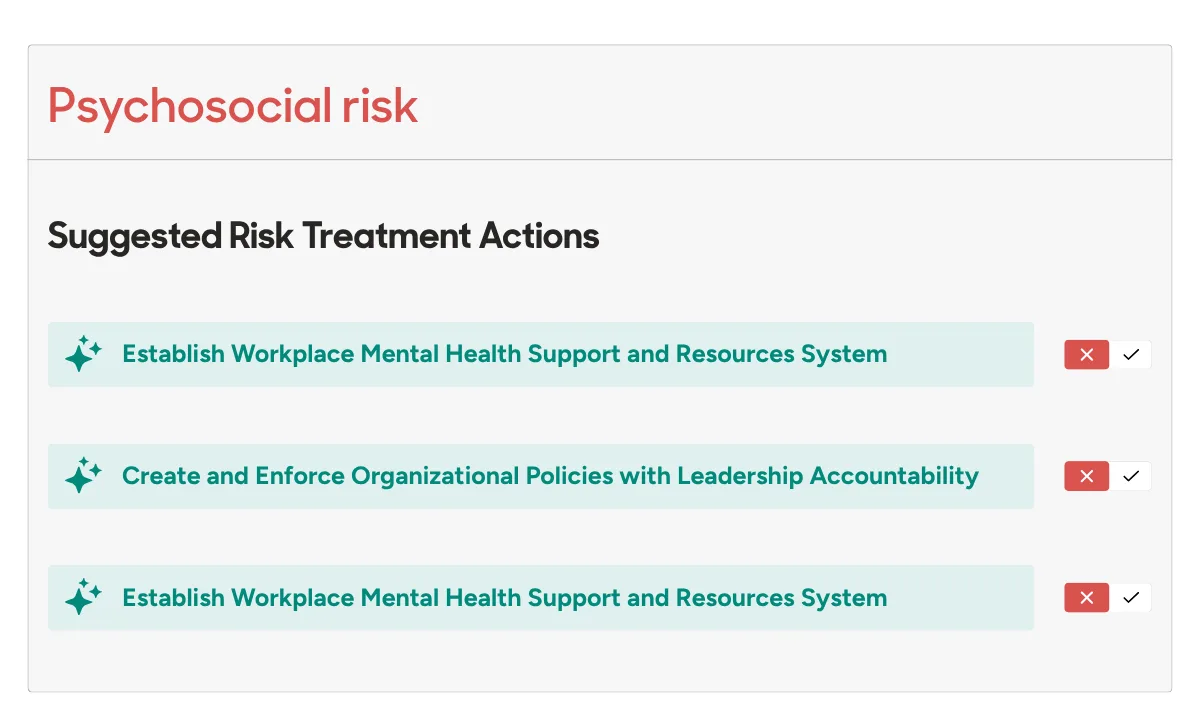
That distinction matters because modern enterprise risk management still depends on human judgement, organisational context and leadership decision-making. What AI can do is help risk teams keep pace with the scale, complexity and speed of the environments they are now expected to oversee.
Why modern risk management is becoming harder, not easier
Today’s organisations face a widening range of interconnected risks: operational resilience, regulatory change, third-party exposure, climate and ESG, workforce, geopolitics and financial volatility. Boards and executive teams want more from the risk function in response. Static risk registers maintained for compliance purposes no longer satisfy the brief. Leadership wants faster reporting, clearer operational insight, stronger governance and better alignment between risk and business performance.
Yet many organisations are still managing risk through disconnected spreadsheets, fragmented governance systems and manually assembled reporting. The result is a familiar problem for risk teams: too much time spent gathering and consolidating information, not enough spent analysing exposure, advising the business and improving resilience.
External conditions are also moving faster than the cadence of most risk reviews. Organisations need to understand not only what their risks are today, but how rapidly changing events may reshape them tomorrow. That is the gap AI risk management is well-suited to close. It is also where the key risks of AI adoption in enterprise settings deserve honest attention, because not every implementation is fit for the environments risk professionals actually work in. Understanding the impacts of ai on governance frameworks, reporting structures and decision-making processes is not optional. It is foundational.
What AI-assisted risk management actually looks like
Used well, AI improves how organisations identify, assess and respond to risk without removing human expertise from the process. AI-assisted risk management is a capability that enhances risk professionals by improving visibility, accelerating analysis and reducing manual administration. The key word is enhances. An AI system that replaces judgement is a liability. One that sharpens it is a genuine advantage.
Concretely, the use of ai in risk management can help identify emerging risk patterns, analyse large volumes of regulatory or policy material, accelerate scenario modelling, surface gaps in controls, improve operational reporting and strengthen enterprise-wide visibility. Risk managers can then spend more time on strategic interpretation, executive engagement and resilience. The benefits of ai in this context are real, but they accrue to organisations that treat the technology as a support layer rather than a decision layer.
The most effective AI-enabled platforms function as intelligent co-pilots for risk professionals, not autonomous decision-making systems. The future of AI in governance, risk and compliance is less about automation and more about augmentation. That is the core principle behind AI-assisted risk management, and it is the lens through which Clew approaches every AI capability built into its platform.
This is where the concept of responsible ai becomes operationally relevant, not just philosophically interesting. It is not enough to deploy an ai model that produces outputs at speed. The question is whether those outputs are interpretable, auditable and connected to accountability. In enterprise risk, where board-level reporting, regulatory obligations and organisational reputation are all in play, the answer to that question has real consequences. Clear ai principles are not a framework for slowing AI adoption. They are the conditions under which adoption produces durable value.
AI risk scenario modelling: where augmentation becomes real
Scenario analysis has traditionally been time-intensive, manual and constrained by the volume of information a risk team could realistically absorb. Advanced ai changes that. It allows organisations to analyse external developments and understand how they may reshape an organisational risk profile far more dynamically.
This is where forward-looking risk management platforms are evolving. Rather than using an ai system simply to summarise documents or automate tasks, more considered approaches apply advanced ai systems to scenario modelling itself, helping organisations test how external developments could shift their risk posture. AI experts working in enterprise contexts consistently flag this as the area where augmentation produces the most meaningful gains: not in replacing analysis, but in widening the range of scenarios a team can realistically work through.
This is the direction Clew is heading with its AI-assisted risk scenario modelling capability. The vision is straightforward: organisations will be able to bring in external material such as climate forecasts, regulatory updates, operational reports or market intelligence, and assess how that information could shift their existing risks, controls and priorities. Rather than waiting for the next quarterly review, risk teams will be able to explore how emerging conditions may affect operational resilience, compliance exposure or strategic objectives as those conditions develop.
That helps risk teams test assumptions faster, spot exposures earlier, support more dynamic governance discussions and improve executive decision-making under uncertainty. The role of the AI system is not to make the final call. It is to give risk professionals richer insight and faster analysis so human judgement can be applied more effectively.
It is also worth being clear about what AI may not yet be capable of. Understanding the dangers of artificial intelligence in sensitive governance contexts is not a reason to avoid it. It is a reason to implement it carefully. Generative ai and generative artificial intelligence tools more broadly can produce plausible-sounding outputs that lack organisational context, and any platform that does not build appropriate human review into that process is compounding risk rather than reducing it. Clew’s position is that ai safety is not an abstract concern. It is a design principle. The deployment of ai in enterprise risk must be governed with clear boundaries that define where the technology operates, what it can surface, and where human sign-off is mandatory.
The broader AI risk landscape enterprise leaders need to understand
The development and use of artificial intelligence in enterprise settings brings genuine opportunity, but it also introduces artificial intelligence risks that governance functions are only beginning to grapple with. AI capability is advancing faster than most regulatory environments can track, and the pace of development of ai shows no sign of slowing. Organisations that treat this as someone else’s problem are accumulating long-term risks that will eventually surface as governance failures.
The threats posed by ai are not primarily the catastrophic risks debated in research circles. For most organisations, the more immediate concerns are misuse of ai in internal processes, ai bias in automated outputs, and the difficulty of maintaining meaningful control of ai when it is embedded across multiple functions without a coherent ai governance framework. These are practical risks, and they are already present in organisations that have moved quickly to deploy ai applications without the oversight infrastructure to match.
The dangers of ai in enterprise contexts are not theoretical. They show up in decisions that cannot be explained, in reporting that cannot be audited, and in accountability gaps that emerge when something goes wrong and no human can clearly own the outcome. Organisations that want to mitigate risks of this kind need to treat responsible ai as a first-order concern, not an afterthought. Efforts to regulate ai are accelerating across major jurisdictions precisely because regulators have recognised that voluntary ai principles are not sufficient on their own. Risk leaders who wait for external pressure to act will find themselves behind.
The benefits and risks of AI are not separate conversations. They are the same conversation, and the organisations navigating it well are the ones that have invested in understanding both. To mitigate these risks does not require limiting what AI does. It requires deploying AI within structures that preserve accountability, transparency and human oversight. Building that oversight capability inside the risk function is one of the more important investments a risk leader can make in the next two years.
Advanced artificial intelligence also raises a question that is relevant to every organisation using AI in consequential decisions: at what point does AI capability approach or begin to exceed human intelligence in specific domains, and what structures need to exist before that happens? That question is not hypothetical in the context of enterprise risk. AI training on large organisational datasets is already producing outputs that non-specialist reviewers cannot fully evaluate. The governance of AI in those environments depends on the quality of the framework around it, not just the quality of the model itself.
The risk manager’s role is expanding, not shrinking
A persistent misconception about AI is that automation reduces the importance of people. The opposite is closer to the truth. As AI-assisted risk management takes on manual effort and improves information visibility, the risk manager’s role becomes more strategic, not less. Risk leaders will spend more time advising executives, interpreting operational trends, supporting business performance, guiding resilience strategy, shaping culture and accountability, and connecting governance to decision-making.
Those are human responsibilities. An ai system cannot fully replicate organisational judgement, ethical reasoning, leadership influence or cultural understanding. Discussions about artificial general intelligence often touch on whether that gap will eventually close, but enterprise risk management today is not operating in that space. Progress in artificial general intelligence remains uneven and contested, and the AI in current enterprise use is narrow, task-focused and dependent on human interpretation to produce meaningful outcomes. Ai development in the GRC sector reflects that reality, and organisations should evaluate platforms on the basis of what AI can demonstrably do now, not on speculative capability.
As organisations become more digitally connected and operationally complex, the need for risk professionals who can interpret uncertainty and guide leadership decisions will grow. The development and use of ai introduces new responsibilities for the risk function: understanding what the technology can and cannot do, establishing governance over how it is used, and ensuring that ai ethics are embedded in the way the organisation operates rather than treated as a compliance checkbox.
Operational resilience is now a defining priority, and businesses need clearer visibility across operational risk, compliance, controls, assurance, incidents, third parties and business continuity. Many GRC platforms have evolved into highly customised environments that require specialist support to operate, and organisations are now moving away from heavyweight approaches that add complexity without improving decisions. Modern risk management platforms are expected to deliver simplicity, configurability, faster implementation, connected visibility and executive-ready reporting. AI accelerates that shift because it works best inside connected, accessible, business-friendly environments. Platforms that use ai technologies to sit on top of fragmented data will always underperform platforms where AI is integrated with clean, structured, organisation-wide information.
What risk leaders should do in the next twelve months
The organisations that succeed over the next decade will not be the ones that try to fully automate governance, risk and compliance. They will be the ones that combine intelligent technology, connected operational visibility, experienced human judgement and strong leadership. Understanding the potential of ai is only half the equation. The other half is knowing how to govern it.
For risk leaders, that translates into four practical priorities:
First, audit where your team’s time actually goes. If more than half is spent assembling information rather than analysing it, that is the first place AI-assisted risk management pays back.
Second, identify two or three scenarios where faster analysis would have changed an executive conversation in the past year, and use those as the test cases for any AI capability you bring in.
Third, agree the boundary explicitly with your executive team: what the ai system is allowed to surface, recommend or flag, and where human sign-off is non-negotiable.
Fourth, invest in the judgement layer. The differentiator over the next decade will not be access to AI, which will be commoditised. It will be the quality of the risk professionals interpreting what it produces.
Get those four right and the technology takes care of itself.
Frequently asked questions about AI-assisted risk management
What is AI-assisted risk management?
AI-assisted risk management is an approach that uses artificial intelligence to support, rather than replace, the work of risk professionals. An AI system handles information gathering, pattern recognition and scenario analysis at scale, while human experts retain responsibility for interpretation, judgement and final decisions.
How is AI used in enterprise risk management?
The use of ai in enterprise risk management includes identifying emerging risk patterns, analysing large volumes of regulatory and policy material, accelerating risk scenario modelling, surfacing gaps in controls, improving operational reporting and strengthening enterprise-wide visibility. The most effective applications treat AI as a co-pilot for the risk function rather than an autonomous decision-maker.
Will AI replace risk managers?
No. AI-assisted risk management expands the risk manager’s role rather than replacing it. As an AI system takes on manual analysis and reporting, risk professionals spend more time on strategic interpretation, executive engagement, governance and resilience, all of which require human judgement that AI cannot replicate.
What is the difference between AI-assisted and AI-controlled risk management?
AI-controlled risk management implies that the system makes risk decisions autonomously. AI-assisted risk management means the AI system augments the risk professional’s analysis and visibility, but humans retain decision authority. The second model is the practical standard for most organisations because it preserves accountability, context and judgement.
What about the risks of deploying AI in risk management?
Responsible ai implementation means being clear about what the technology can and cannot do. Potential risks include outputs that lack organisational context, over-reliance on automation, and ai safety gaps in sensitive governance workflows. The answer is not to avoid AI, but to deploy it with human oversight built in by design.