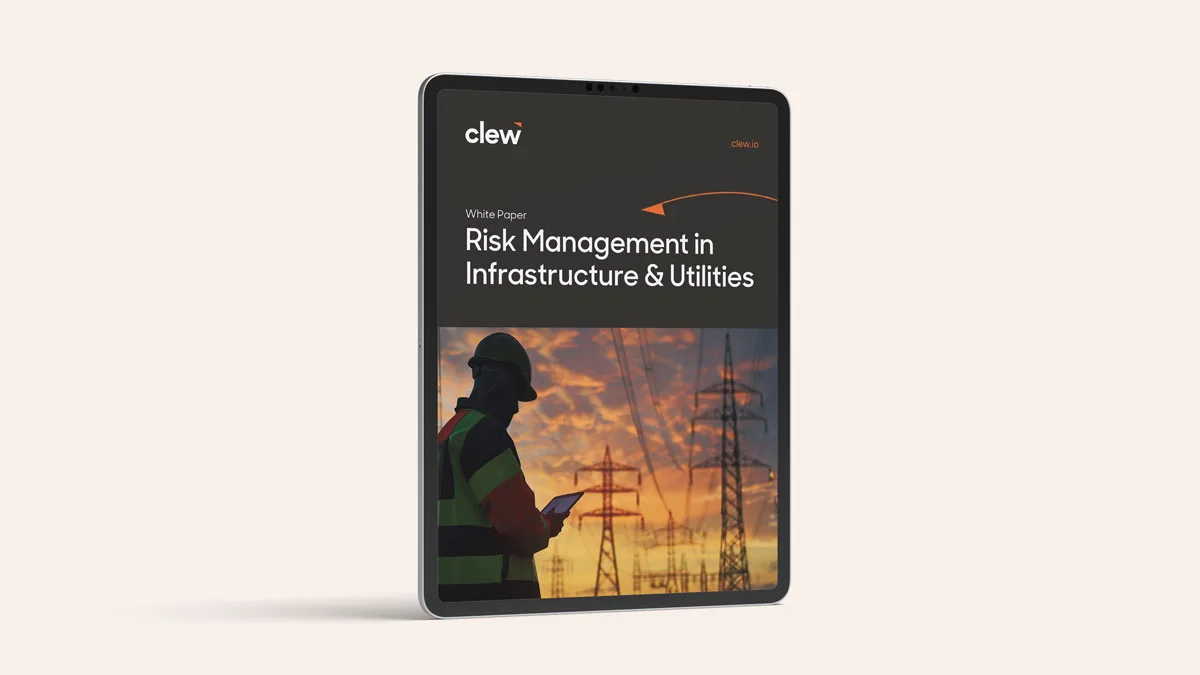
Risk Management for Infrastructure and Utilities: From Compliance to Intelligence
Energy networks, water systems, and transport corridors are under more pressure than ever. Ageing assets, climate volatility, cyber exposure, and rising public scrutiny have fundamentally changed what good risk management looks like in this sector. Yet for many infrastructure and utility organisations, risk management still operates as a largely retrospective function; registers maintained, audits completed, boxes ticked. This white paper from Clew examines why that model is no longer sufficient, and what it takes to use risk as a genuine decision-making capability.
Why Infrastructure Risk Management Needs to Change
Failure in infrastructure is rarely caused by unknown risks. More often it stems from known risks that were poorly prioritised, misunderstood, or disconnected from the decisions that actually shaped investment and performance. The gap between identifying risk and acting on it is where resilience erodes.
This white paper explores the shift from compliance-led to performance-based risk management for infrastructure. It draws on real examples from organisations including National Grid ESO, Network Rail, Australian water utilities, and the Crossrail programme to show where mature risk thinking has strengthened resilience and where fragmented governance has allowed problems to develop unchecked. The central argument is that success in this sector is no longer defined by the absence of incidents, but by the quality and speed of the decisions that risk information enables.
Governance, Culture, and the Decisions That Define Resilience
One of the most important themes in the white paper is the relationship between governance and culture. In infrastructure and utilities, risk management fails less often because controls are absent and more often because decision rights, incentives, and behaviours are misaligned. When risk appetite is vague or detached from performance measures, governance creates the illusion of control while leaving critical decisions unresolved until after failure occurs.
The paper examines how strong risk cultures differ from weaker ones in practical, observable ways: how quickly issues are escalated, whether bad news travels without dilution, and whether assurance findings actually lead to action. It also looks at the role of integrated assurance, bringing together technical audits, safety inspections, financial controls, and programme oversight into a single governance view, so that boards can assess whether exposure remains within defined appetite rather than reviewing disconnected reports from separate functions.
From Data to Decision Velocity in Utilities and Infrastructure
Risk management for utilities and infrastructure now operates in an environment of real-time data, digital twins, and remote monitoring. The challenge is not generating insight but ensuring it reaches the right people at the right time and in a form that changes decisions. The white paper addresses how leading organisations are building risk functions that act as internal translators between data and decision, and how integrated risk and assurance platforms are replacing static registers with live views of exposure across the enterprise.
Who This White Paper Is For
This white paper is written for risk directors, infrastructure executives, and heads of assurance who are responsible for managing complex, interconnected risk across large asset portfolios. It is also directly relevant to board members and audit committee chairs in energy, water, and transport organisations who need confidence that the risk picture they receive is accurate, current, and connected to operational reality. If your organisation is navigating the shift from compliance-based reporting to genuine risk intelligence, this paper sets out a clear path forward.
The infrastructure and utility sectors sit at the forefront of a new model of risk-informed governance. Download the white paper to find out what it takes to get there.