


Critical controls are the critical few. They are the specific measures that prevent a high-consequence event or limit its impact, and each needs a performance standard, an owner and regular verification.
Verification is the whole point. A critical control that is not checked in the field is an assumption, not a control.
It now belongs in enterprise risk management. ICMM’s 2026 guide positions critical control management as a core element of enterprise risk management, visible in strategic risk registers.
The board pack showed injury rates at a five-year low. Three days later, a haul truck reversed over a light vehicle in the pit. The driver had stepped out four minutes earlier.
The proximity detection that should have stopped the truck had been bypassed for a fortnight. The site knew. Nobody above it did. The board was looking at a lagging indicator that measured what had already happened, while the control standing between a near miss and a fatality was quietly failing.
That gap is what critical control management is for. In April 2026, ICMM published an updated guide that goes further, positioning critical control management as a core element of enterprise risk management. This guide explains what critical control management is, what changed in 2026, how to choose and verify critical controls, how to report them to leadership, and how they fit with the rest of an organisation’s controls, with a worked example.
What Is Critical Control Management?
Critical control management is a structured approach to preventing the most serious events an operation could suffer. It identifies the few controls that matter most, sets clear standards for them, assigns owners, and checks in the field that they work. It was developed in the mining and metals industry, where ICMM first published good practice guidance on it in 2015, and it is now used in other high-hazard industries. Some organisations call it critical risk management, and describe the events it targets as their critical or fatal risks.
The events it targets are called material unwanted events: incidents that could cause a fatality, multiple serious injuries, serious harm to health or a catastrophic loss. A critical control is one that, on its own, prevents a material unwanted event or significantly limits its consequences, so that its absence or failure would sharply increase the risk. ICMM describes critical controls as the specific measures that prevent high-consequence events or mitigate their impacts, each needing clear performance standards, defined ownership and regular verification.
What Changed in ICMM’s 2026 Critical Control Management Guide
ICMM published its updated Critical Control Management: Good Practice Guide on 28 April 2026, ten years after the first. According to ICMM’s announcement of the guide, the update does five things.
- It merges the previous good practice and implementation guides into a single, more practical document.
- It positions critical control management as a core element of enterprise risk management, and increases the visibility of critical controls in strategic risk registers.
- It gives stronger direction on planning, governance and leadership, with new maturity assessments and readiness checks.
- It sets stronger criteria for identifying, implementing and verifying critical controls.
- It puts more emphasis on organisational culture and frontline engagement, including the gap between how work is planned and how it is actually done.
The second change matters most outside the safety function. Critical controls are no longer only a site safety matter. They are part of how an organisation manages its most serious risks, and the board should be able to see whether they are working.
What Makes a Control Critical
Most operations have hundreds of controls. Only a few are critical. Four questions help to separate them.
- Does the control, on its own, prevent the material unwanted event or significantly limit its consequences?
- Would its absence or failure sharply increase the risk, even with every other control in place?
- Can its performance be specified and measured?
- Can it be verified in the field, by someone who knows the work?
If the answer to all four is yes, the control is a candidate. The aim is the critical few for each event, not a long list. Twenty critical controls for one event usually means nothing has really been prioritised.
A procedure or a training course is rarely critical on its own, because its performance depends on people following it every time. Engineered controls, such as interlocks, guards and physical separation, are the strongest candidates, as types of risk controls and the hierarchy of controls both suggest.
Material Unwanted Events and the Bowtie
Critical control management starts with the events, not the controls. Identify the material unwanted events for the operation. In mining, typical examples include vehicle collisions, fall of ground, uncontrolled release of energy and fire. ICMM’s recent safety insights work, for example, focuses on fall of ground and inrush events.
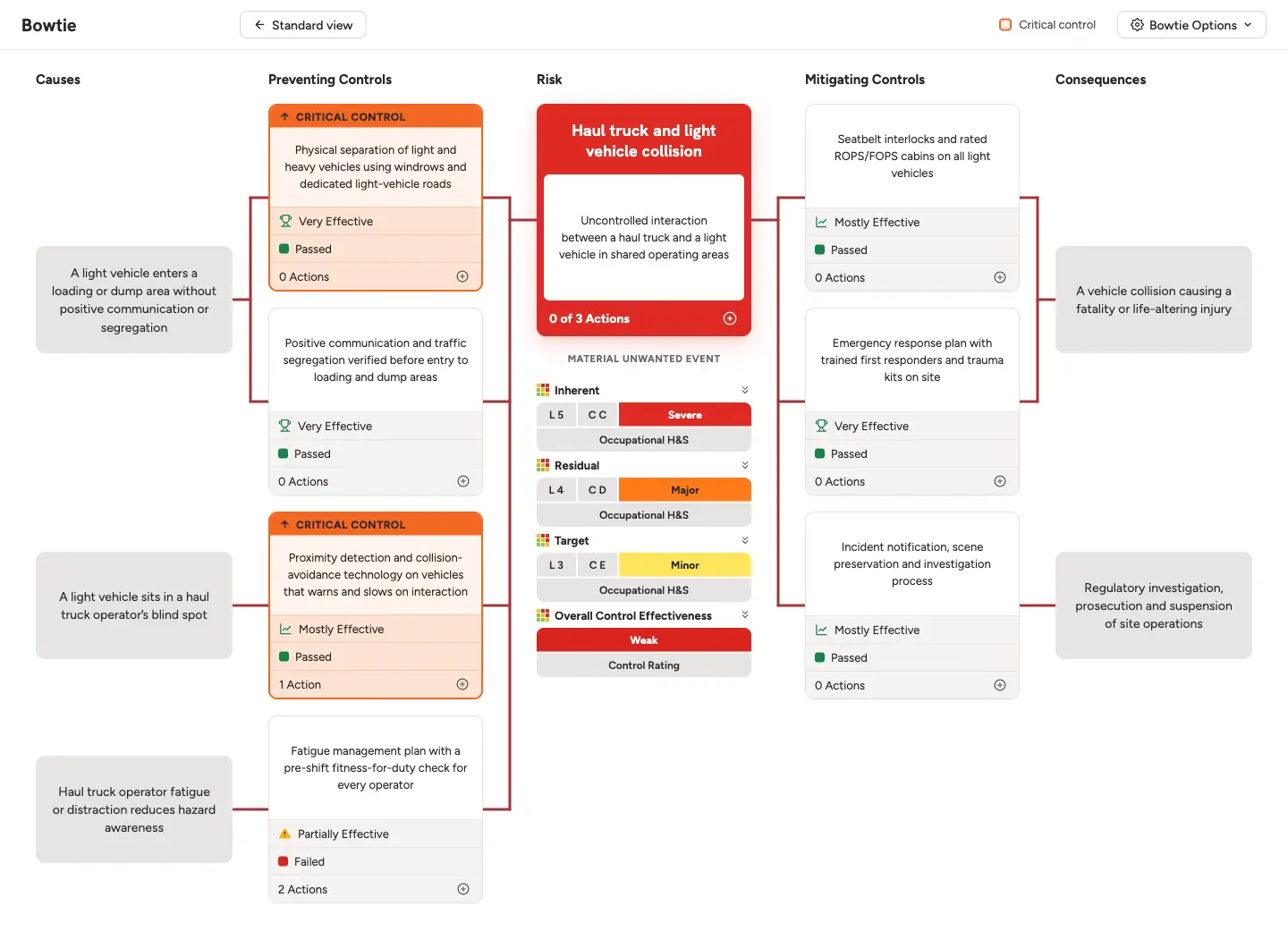
For each event, a bowtie maps the causes on one side, the consequences on the other, and the controls in between. That makes it easy to see which controls prevent the event and which limit its consequences, and where a single control carries most of the load. Bowtie analysis explains the method.
Setting Performance Requirements for Critical Controls
Every critical control needs a performance requirement that says what good looks like. Five parts cover it.
| Part | What it states | Example: proximity detection on haul trucks |
|---|---|---|
| Objective | What the control must achieve | Stop or warn a haul truck before it reaches a light vehicle or a person |
| Performance standard | The measurable standard it must meet | Detects light vehicles within the set range, and is working on every truck in use |
| Owner | The one person accountable | Mine operations manager |
| Verification | How, how often and by whom it is checked | Pre-start test by the operator each shift; weekly field check by the supervisor; monthly system report reviewed by the owner |
| Trigger for action | What happens if it fails | The truck does not operate until it is repaired, and any bypass is reported to the owner the same shift |
Why a performance requirement comes first
Without a performance requirement, verification has nothing to check against.
How to Verify Critical Controls
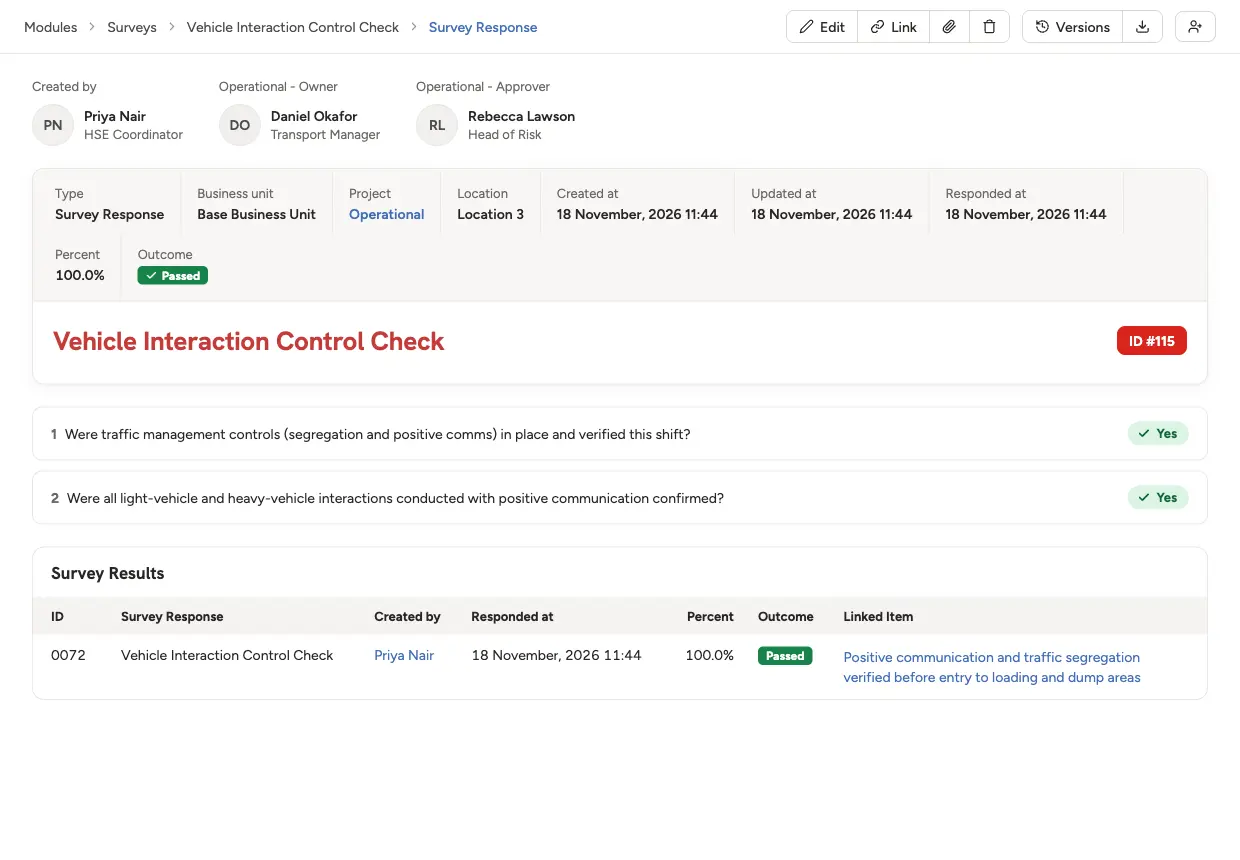
Verification is the step most programmes get wrong. It means checking, in the field and at a set frequency, that a critical control meets its performance requirement in practice, not that paperwork has been completed.
- Verify at more than one level, so operators and supervisors check daily or weekly, owners review the trends, and managers carry out periodic deeper checks.
- Use people who understand the work, and ask open questions about how the control is really used.
- Treat a failed verification as an event in its own right, by restricting the work, fixing the control and reporting it upwards.
- Look for the gap between how work is planned and how it is actually done, because that is where critical controls quietly fail.
A verification that always passes deserves a second look. It may mean the control is reliable, or it may mean the check is too easy. How to test controls more generally is covered in how to assess control effectiveness.

A critical control that is not verified is an assumption, not a control.
Reporting Critical Control Status to Leadership
Injury rates tell leaders what has already happened. Critical control status tells them what could happen next. Report both.
For each material unwanted event, leadership should see three things.
- The number of critical controls in place and meeting their performance requirement.
- Which controls have failed verification, and what has been done about each one.
- Whether verification is being completed on schedule.
That is a leading indicator, and it belongs alongside the lagging ones in the board’s risk report, as key risk indicators explains. ICMM’s 2026 guide makes the same point at enterprise level: critical controls should be visible in the strategic risk register, not only in site safety reports.
Safety and critical control management software records each critical control against its material unwanted event, with its owner, performance requirement and verification results, and shows control status alongside the enterprise risk register.
Critical Controls, Control Types and the Hierarchy of Controls
Critical control management works alongside the rest of an organisation’s thinking about controls, not instead of it.
- The four types of control show what a critical control does: preventive critical controls act before the event, and mitigating ones act after it.
- The hierarchy of controls shows how reliable it is: an engineered control that removes or isolates the hazard is far more dependable than a procedure.
- Control effectiveness testing shows whether it works in practice.
A critical control should score well on all three. If a material unwanted event depends on a procedure and a training course, the bowtie is telling you to look for an engineered control.
Worked Example: Haul Truck and Light Vehicle Collision
Here is the method applied to one material unwanted event at an open-pit mine: a collision between a haul truck and a light vehicle.
| Critical control | Type | Performance standard | Verification |
|---|---|---|---|
| Proximity detection and collision avoidance on haul trucks | Preventive, engineered | Working on every truck in use; detects light vehicles within the set range | Pre-start test each shift; weekly supervisor field check; monthly system report |
| Physical separation of light vehicles from haul roads | Preventive, engineered | Barriers and separate routes in place at every crossing and work area | Weekly inspection of barriers and routes; check after any road change |
| Light vehicle visibility: flags, lights and beacons | Preventive, engineered | Fitted and working on every light vehicle before it enters the pit | Gate check at pit entry each shift |
| Positive communication before entering a haul road | Preventive, procedural | Light vehicles obtain clearance by radio before entering | Monthly field observation of entries; review of radio logs |
| Emergency response to a vehicle collision | Mitigating | The response team reaches any pit location within the set time | Quarterly drill, timed against the standard |
The positive communication protocol is the weakest of the five, because it depends on people. The operation keeps it but does not rely on it: three engineered controls carry the prevention.
Go back to the opening. The bypassed proximity detection would have failed its pre-start test on the first shift, and the trigger in its performance requirement would have kept the truck parked. With control status reported upwards, the bypass would have reached the owner the same shift, and the board’s report would have shown a failed critical control alongside the injury rate.
Critical Control Management Beyond Mining
The approach was built in mining, but it works wherever an event could kill someone. In construction, critical controls for falls from height include edge protection and fall arrest systems. In utilities and infrastructure, they include energy isolation before maintenance and gas testing before confined space entry. In transport, they include separating people from moving plant in depots. The method is the same everywhere: name the event, find the critical few, set standards, verify in the field and report status.
Common Critical Control Management Mistakes
- Too many critical controls. If everything is critical, nothing is.
- Procedures labelled critical. A control that depends entirely on people following it every time is rarely critical on its own.
- Verification as a tick-box. A checklist completed in the office is not a field verification.
- No status reporting. If leaders only see injury rates, they find out about failing controls after an event.
- No link to the risk register. Critical controls that live only in a safety system stay invisible to enterprise risk management, which is exactly what ICMM’s 2026 guide sets out to change.
Frequently Asked Questions
What is critical control management?
Critical control management is a structured approach to preventing the most serious events an operation could suffer, by identifying the few controls that matter most, setting performance standards for them, assigning owners and verifying in the field that they work.
What is a critical control?
A critical control is one that, on its own, prevents a material unwanted event or significantly limits its consequences, so that its absence or failure would sharply increase the risk. It needs a clear performance standard, an owner and regular verification.
What is a material unwanted event?
A material unwanted event is an incident that could cause a fatality, multiple serious injuries, serious harm to health or a catastrophic loss, such as a vehicle collision, fall of ground or uncontrolled release of energy.
How do you verify critical controls?
Check in the field, at a set frequency and at more than one level, that each critical control meets its performance requirement in practice. Treat a failed verification as an event: restrict the work, fix the control and report it.
How many critical controls should a material unwanted event have?
There is no fixed number, but the aim is the critical few. A small number of controls that each prevent or limit the event on their own is far easier to verify than a long list in which nothing has been prioritised.
What changed in ICMM's 2026 critical control management guide?
Published on 28 April 2026, the update merges ICMM’s earlier good practice and implementation guides, positions critical control management as a core element of enterprise risk management, and strengthens guidance on governance, leadership, verification and culture, with new maturity assessments and readiness checks.
Put your critical controls to work. Clew is a risk and assurance platform built around the Golden Thread: the traceable link from an organisation’s objectives through its risks, controls, actions and assurance to the indicators that show whether it is performing. Risk, safety and assurance teams in government, healthcare, construction, infrastructure and utilities, mining and resources, and transport use Clew to keep their risks, controls and indicators connected to the objectives they protect. See it with your own critical controls: request a demo of Clew, or explore Clew’s safety and risk management software.