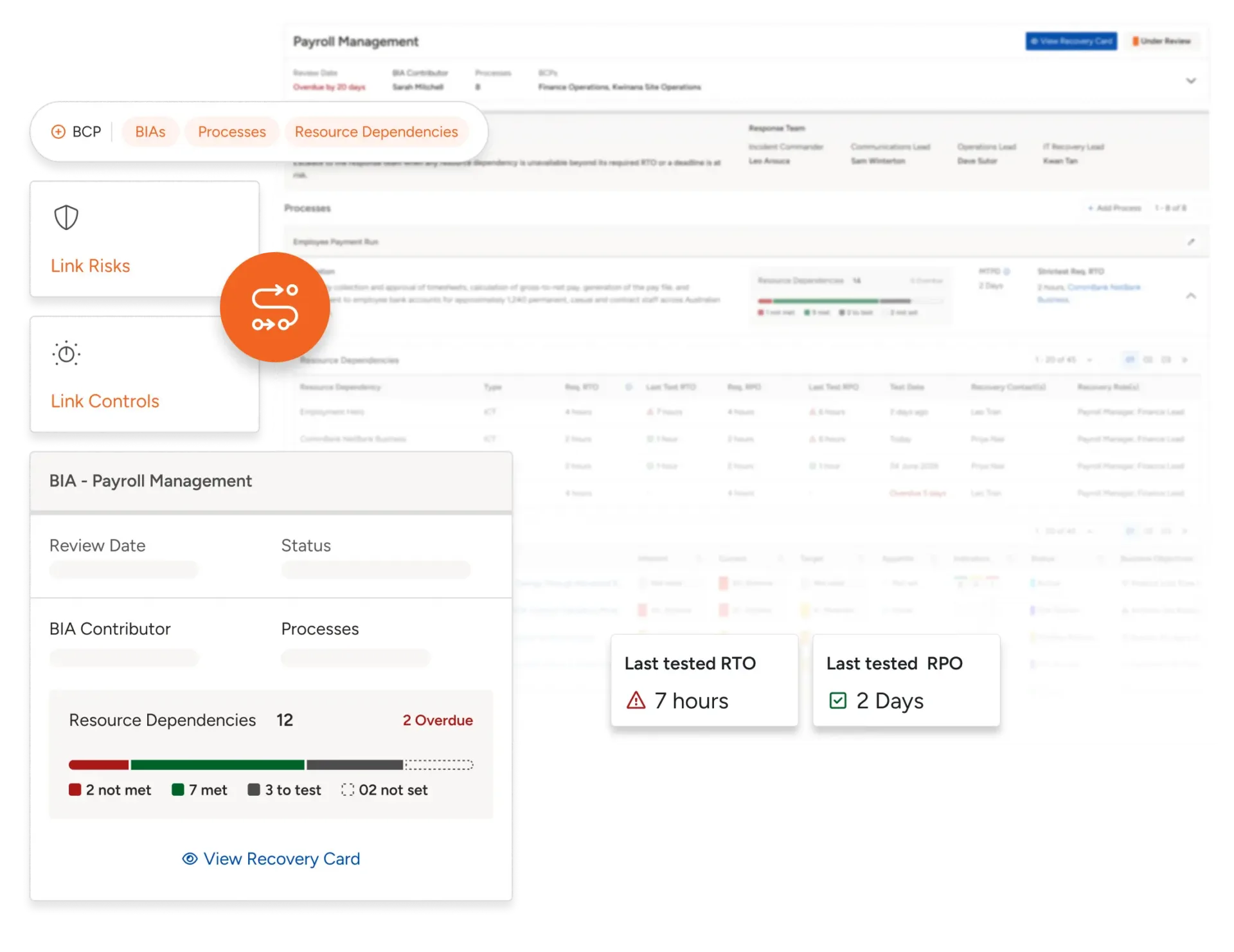
Business Impact Analysis
Connected Continuity Plans
Recovery Targets in Context
Tested Versus Planned Gap Reporting
Action Cards for the First Ten Minutes
Incident to Plan Navigation
Additional business continuity capabilities
- Program-level monitoring dashboard
- Reusable activities and systems across plans
- Structured approval from draft to activation
- Automated review reminders and review cadences
- Full audit trail with timestamp and author
- Recovery teams assigned per system, action or role
- Configurable tagging of critical activities and systems
- Full plan PDF export, readable without platform access
- Role-based access control and tamper-proof audit trails
- Connected to Clew Risk, Compliance, Audit and Safety
We Know That One Size Doesn’t Fit All
Your Hub for Risk and Assurance Resources
Guides, articles and expert insights from Clew's risk and assurance team, covering everything from emerging trends in risk management to best practice in compliance, audit and safety. Practical resources built to help you manage risk with confidence.
Your business continuity questions, answered
What is business continuity software?
Business continuity software helps organisations work out which activities are critical, plan how to recover them, and keep those plans current. Clew goes further by holding continuity plans in the same platform as your risks, controls and incidents, so the plan and the register that justifies it never drift apart.
What is a Business Impact Analysis, and why does it come first?
A Business Impact Analysis identifies the activities your organisation depends on, the systems behind them, and the impact if they were unavailable. It comes first because you cannot set sensible recovery targets before you know what is critical. In Clew, one analysis can be promoted into a plan, or several combined, without re-keying anything.
How does Clew link continuity plans to risks and controls?
Each critical activity is linked to risks and controls already held in Clew. The relationship is visible from both directions: open a plan and see the risks it answers, or open a risk and see every plan it appears in.
This is the Golden Thread applied to resilience. Knowing a risk exists is not the same as knowing what happens when it materialises, and the continuity plan is where that second question gets answered.
What are recovery time and recovery point objectives, and how does Clew handle them?
A recovery time objective is how quickly a system must be back. A recovery point objective is how much data loss is acceptable. Clew sets both in the context of the activity rather than the system alone, because the same system can be urgent for one activity and patient for another.
Take paying staff on time. The payroll platform may need to be back within four hours with no more than fifteen minutes of data lost, while the HR database behind it can take twenty-four hours because an hour of entries can be re-keyed. One activity, several systems, different tolerances.
How do we prove a plan has actually been tested?
Record the last tested recovery result and test date against each system. Clew compares tested performance against the plan and flags the shortfall automatically. Those gaps surface on the plan itself and carry through to every export, so evidence for auditors, tenders and board reporting is a query away rather than a folder dig.
What happens if Clew is unavailable during an incident?
Plans export two ways, for two different jobs. The full plan PDF is a standalone, formatted document containing the complete plan, readable without platform access. Action cards are role-specific exports filtered by team or system type, concise by design and built for the first ten minutes.
What is the difference between business continuity and disaster recovery?
Disaster recovery is concerned with restoring technology: systems, data and infrastructure. Business continuity is concerned with keeping critical activities running, which usually depends on people and process as much as technology.
Clew holds both in one structure by attaching systems, and their recovery targets, to the activities they support. The technical recovery detail stays connected to the business reason it matters.
Can continuity planning be added to an existing Clew deployment?
Yes. Continuity is a module inside the same platform, drawing on the register you already maintain rather than standing beside it. Existing customers should speak to their Customer Success contact about scope and timing. New customers can include it from the outset in a quote.
How long does implementation take?
Clew is quick to implement, typically in weeks rather than months, using pre-configured templates and best-practice frameworks built for the mid-market. Continuity follows the same approach. Start with one set of critical activities, prove the structure, then extend across the organisation.
Who in the organisation actually uses it?
Continuity is not owned by one team, so the module is built so each audience sees the slice they need without rebuilding the plan.
Risk and resilience managers get a single source of truth connected to the register, with review cadences that hold themselves together. Subject matter experts and operational leads get role-specific action cards in the right hands before an incident starts. Executives and the board get quantified impact at activity level, and visibility of tested versus required recovery before a real event.
Why do business continuity plans fail, and how do you avoid it?
Plans fail for predictable reasons. The plan sits in a document on someone’s drive. It references risks that have moved on, controls that have been replaced, and recovery targets that were set once and never tested. The register that justifies the plan lives in a different system, so the two run in parallel until an incident exposes the gap.
Ownership is usually the root cause. If nobody owns the activity, nobody owns the plan, and review becomes an annual document refresh rather than a live capability.
Avoid this by holding the plan where the risks and controls already sit, assigning an owner and review cadence from the start, and recording tested results rather than assumed ones. A connected, current plan is worth more than a comprehensive one that is out of date.
What should we look for when comparing business continuity planning software?
Focus less on feature volume and more on whether the tool reflects how your organisation actually works. Five questions separate most options quickly.
- Can plans connect to the risks and controls you already manage, or does the tool need its own copy of them?
- Can recovery targets be set per activity, not only per system?
- Does the platform tell you where tested performance falls short of plan, or does it only store what you typed?
- Will the plan still be readable when the platform is not reachable?
- Can leadership get a straight answer on resilience without a manual exercise first?
A platform that connects objectives, risks, controls, assurance and continuity in one view supports real decisions. That matters more than any feature checklist.