


There are four types of control. Preventive controls stop a risk event happening, detective controls spot it, corrective controls limit and repair the damage, and directive controls set the rules.
Each type changes something different. Preventive controls mainly reduce likelihood; corrective controls mainly reduce consequence.
Balance matters more than numbers. A risk with many controls can still be poorly defended if they are all procedures and after-the-event measures.
The register listed eleven controls against loss of supply. On paper, the risk looked well defended.
Then someone sorted the controls by type. Seven were procedures, policies or training. Two were alarms. The other two only came into play once supply had already been lost. Nothing actually stopped the failure from happening.
That is why the types of risk controls matter. A count of controls says how busy a register is. The types say how well defended a risk really is. This guide covers the four types of controls in risk management, what each one does, which reduce likelihood and which reduce consequence, how they relate to the hierarchy of controls, and how to classify the controls in your own register, with a worked example.
What Are Risk Controls?
A risk control is an ongoing measure that changes the likelihood of a risk, its consequence, or both. It is in place now rather than planned, and it should be measurable, monitored and owned by a named person, as the University of Exeter’s guidance on risk control types sets out.
Before looking at the types of risk controls, one rule: planned actions are not controls until they are in place and working. That distinction matters, because a register that counts planned actions as controls overstates how well a risk is managed, and the residual risk rating that follows will be wrong.
The Four Types of Controls in Risk Management
Many organisations group their risk management controls into four types.
| Type | What it does | Example | Mainly reduces |
|---|---|---|---|
| Preventive | Stops the risk event happening | An interlock that stops a machine starting while its guard is open | Likelihood |
| Detective | Spots that the risk is developing or has happened | A telemetry alarm on falling reservoir levels | Likelihood or consequence, depending on how early it acts |
| Corrective | Limits the damage and puts things right | An emergency response plan; a standby generator | Consequence |
| Directive | Sets the rules people must follow | A safe system of work, a policy or a training requirement | Likelihood, but only if people follow it |
Preventive Controls
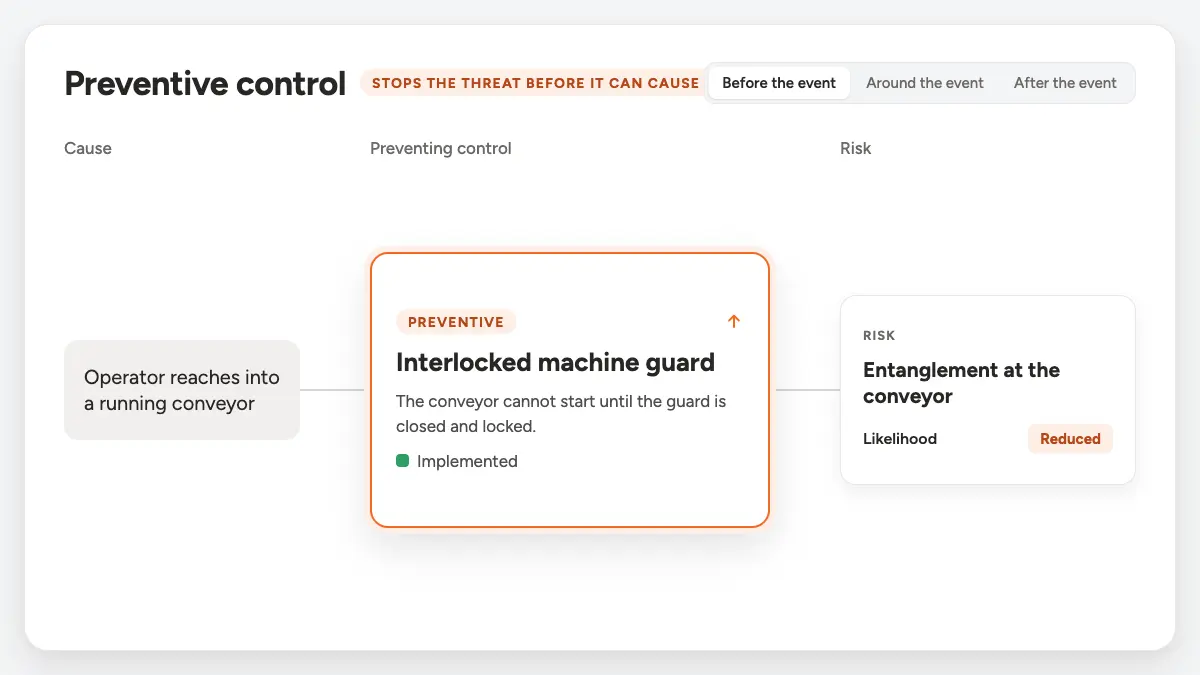
Preventive controls stop the risk event from happening in the first place, by acting on its causes. In operations they include physical interlocks, isolation and lockout, permit-to-work systems that block access until checks are complete, planned maintenance that removes a failure before it occurs, and two-person approval for high-consequence decisions.
Preventive controls are usually the most effective type, because they do not depend on anyone noticing a problem in time. They are also the hardest and most expensive to put in place, which is why many registers have fewer of them than they should. You will also see them called preventative controls; the two words mean the same thing.
Detective Controls
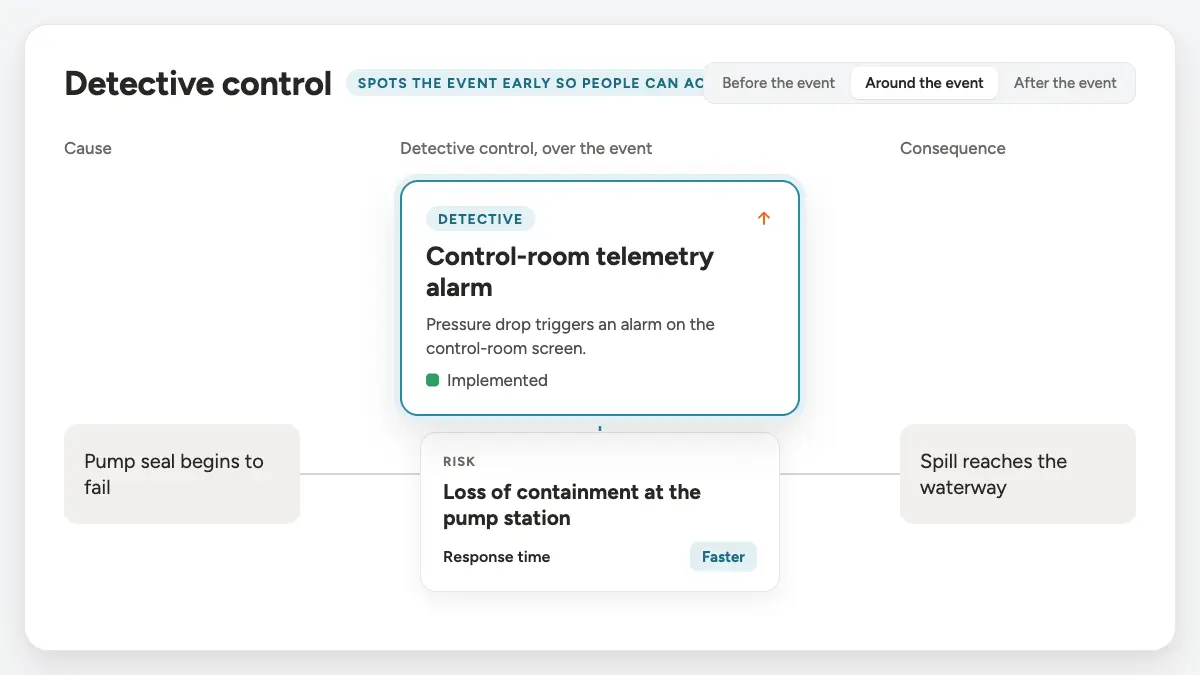
Detective controls spot that a risk is developing or that an event has happened. They include inspections, alarms and sensors, reconciliations, audits, and key risk indicators that warn when a measure is moving towards its limit.
A detective control that acts early, while there is still time to intervene, reduces likelihood. One that only confirms the event has happened reduces consequence, by starting the response sooner. Either way, a detective control is only as good as the response it triggers. An alarm that nobody acts on is not a control, so every detective control should be paired with a corrective response, and the register should show both.
Corrective Controls
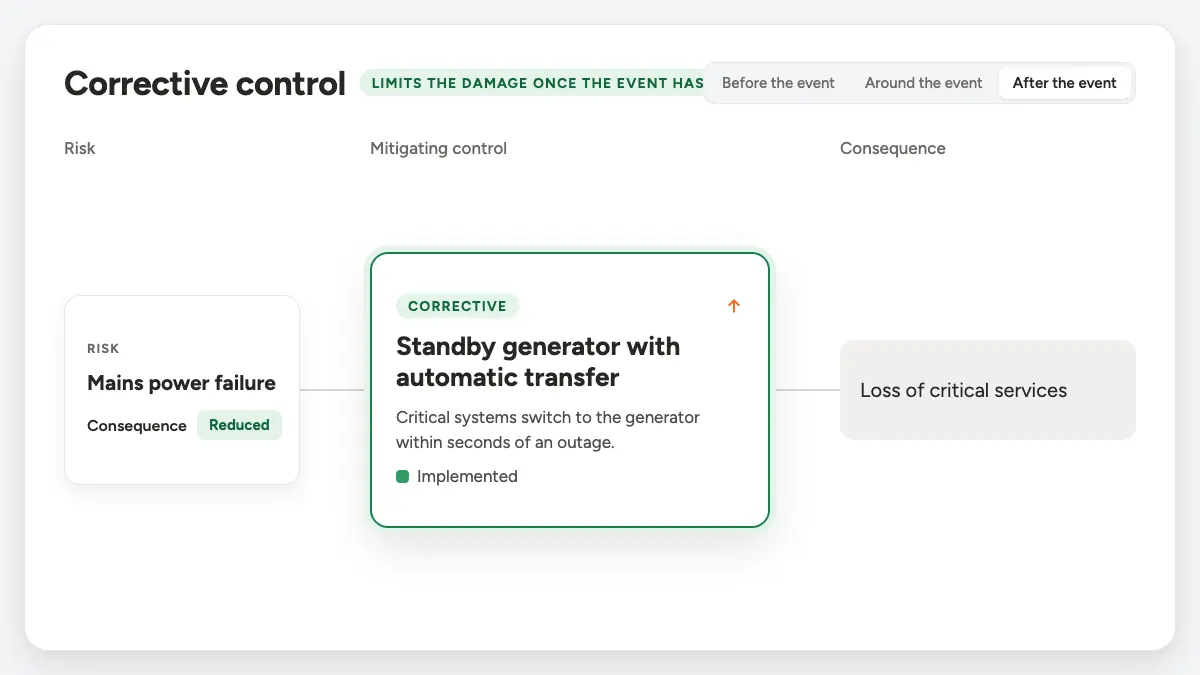
Corrective controls limit the damage once a risk event has happened, and put things right afterwards. They include emergency response plans, standby equipment, business continuity plans, recovery procedures and incident investigations that fix the cause.
Corrective controls reduce consequence, not likelihood. A risk defended mainly by corrective controls will still happen as often as before; it will simply hurt less when it does. Some organisations call these responsive or mitigating controls.
Directive Controls
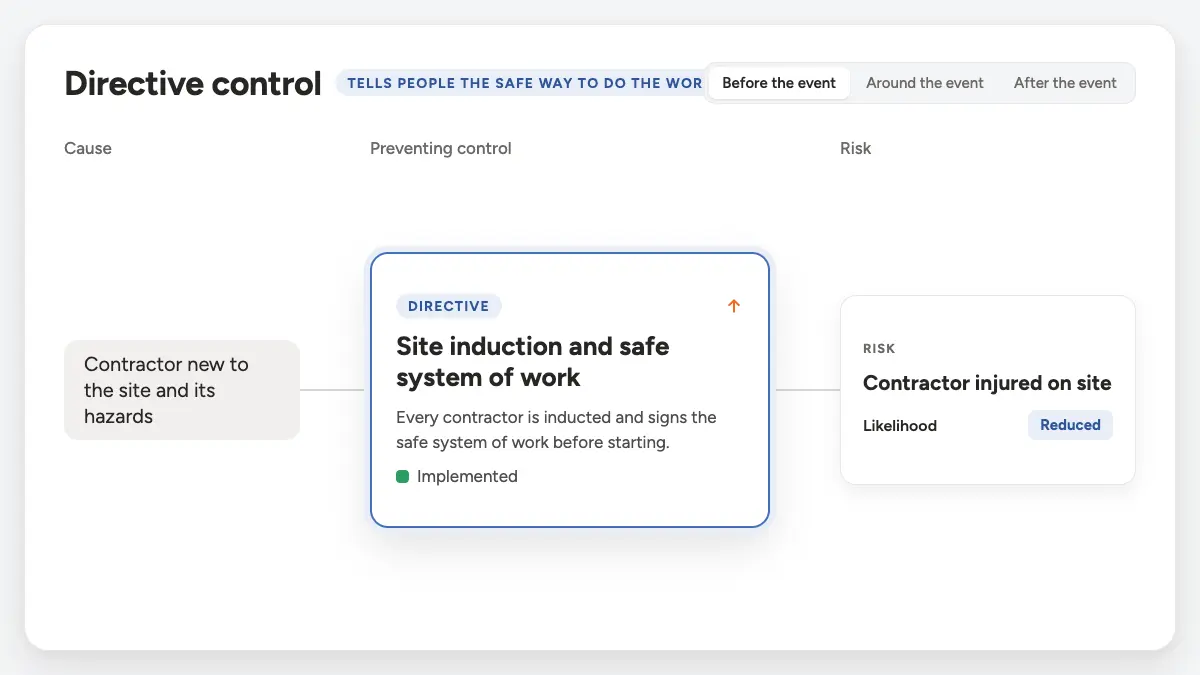
Directive controls set the rules: policies, procedures, safe systems of work, training and supervision. They are the most common type in most registers, because they are the easiest to create.
On their own, they are also the weakest. A directive control only works if people follow it every time, and it needs detective and corrective controls behind it, to show whether it is being followed and to deal with the times it is not. A high risk held back by directive controls alone is the first thing to look for in any register.
A count of controls tells you how busy a register is. The types tell you how well defended a risk really is.
Which Controls Reduce Likelihood, and Which Reduce Consequence
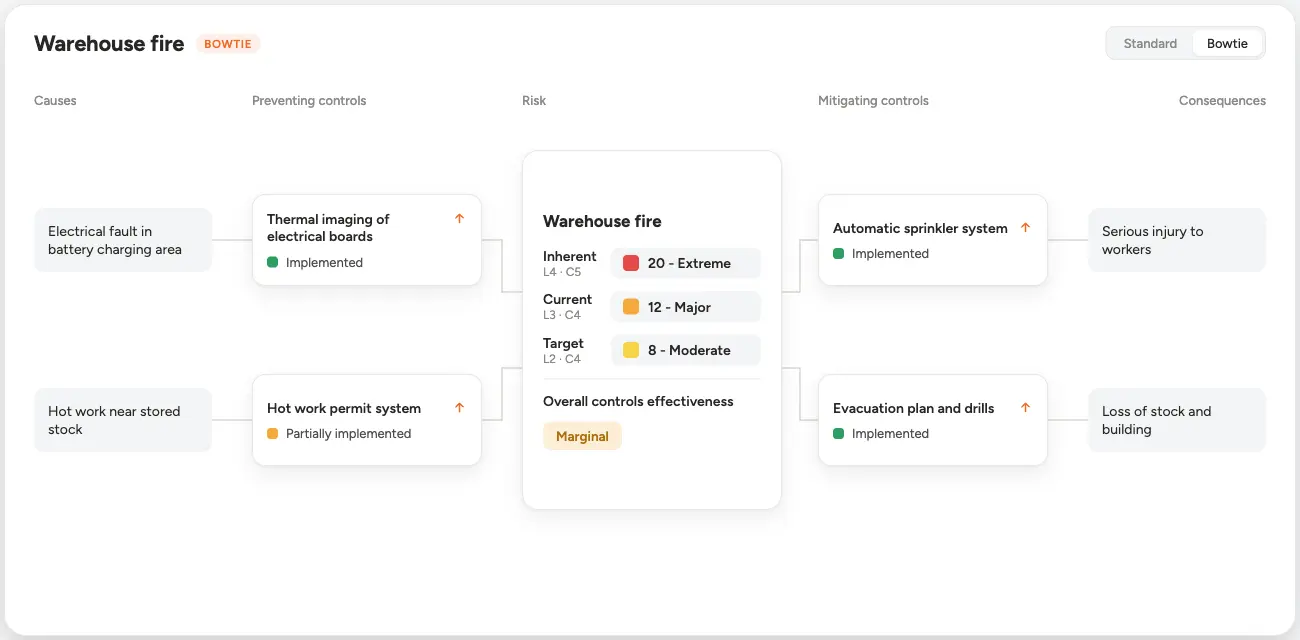
A useful way to see the four types together is the bowtie, with the risk event in the middle, its causes on the left and its consequences on the right.
Swipe sideways to see the whole bowtie.
- Preventive controls stop a threat from causing the top event, such as fatigue monitoring.
- Directive controls tell people what to do, such as haul road rules and procedures.
- Detective controls spot the event as it starts, such as a proximity alarm.
- Corrective controls limit the consequences once the event happens, such as ROPS and seatbelts.
| Position on the bowtie | Control types | Effect |
|---|---|---|
| Before the event (the threat side) | Preventive and directive | Reduce likelihood |
| Around the event | Detective | Early detection reduces likelihood; late detection reduces consequence |
| After the event (the consequence side) | Corrective | Reduces consequence and speeds recovery |
This is why a serious risk needs controls on both sides. Strong prevention with no corrective controls leaves you exposed when prevention fails. Strong corrective controls with no prevention mean the event keeps happening. Bowtie analysis maps this in detail.
Control Types and the Hierarchy of Controls
The four types describe what a control does. The hierarchy of controls, used in health and safety, describes how reliable it is: eliminating the hazard first, then substitution, then engineering controls, then administrative controls, and finally personal protective equipment.
The two work together. An engineered preventive control, such as a guard or an interlock, is far more reliable than a directive procedure that tells people to take care. When a register shows a high risk defended by procedures and training, the hierarchy explains why that defence is weak, and the control types show what kind of control to add.
How to Classify the Controls in Your Risk Register
Sorting the controls on a risk into the four types of risk controls takes minutes, and it often changes how the risk is rated.
- List the controls against each risk, keeping only measures that are in place now.
- Give each control one primary type, based on what it does to the risk, not what it is called.
- Check the balance for each risk, looking for preventive controls on the threat side and corrective controls on the consequence side.
- Check that every detective control has a response, so each alarm, inspection or indicator leads to a named corrective action.
- Act on the gaps, starting with the highest risks, by adding or strengthening the missing type, and record it as a treatment action.
Four warning signs are worth looking for as you go.
- A high risk with directive controls only.
- No preventive controls on a risk that could cause serious harm.
- Detective controls with no corrective response.
- Planned actions counted as controls.
Once the controls are classified, the next step is to assess whether each one actually works. Purpose-built risk management software keeps each control against the risk it affects, with a named owner and reminders, so the balance of controls is visible across the register rather than buried in a spreadsheet.
Worked Example: Classifying the Controls on One Risk
Here is the method applied to the loss-of-supply risk at a UK water utility, using six of its eleven controls.
| Control | Type | Effect |
|---|---|---|
| Planned maintenance programme for treatment works equipment | Preventive | Reduces the likelihood of equipment failure |
| Telemetry alarms on reservoir and pump levels | Detective | Gives early warning, so action can start before supply is lost |
| Operating procedures and operator training | Directive | Reduces likelihood, if followed |
| Standby generator at the main works | Corrective | Limits the consequence of a power cut |
| Emergency response and customer communication plan | Corrective | Limits the consequence once supply is affected |
| Supply interconnect with a neighbouring works | Corrective | Keeps some supply flowing if the works fails |
Once the controls are sorted, the picture is clear. One preventive control, the maintenance programme, holds the threat side, and it has a backlog. Three corrective controls do the heavy lifting on the consequence side. The fix is not more procedures. It is stronger prevention: clearing the maintenance backlog, and adding condition monitoring on critical pumps, a detective control that acts early enough to prevent failure.
Some organisations would class the standby generator as preventive, because it prevents a power cut from becoming a loss of supply. What matters is classifying consistently, and showing which side of the risk each control protects.
Common Mistakes When Classifying Controls
- Counting controls instead of classifying them. Eleven controls can still leave a risk exposed.
- Relying on directive controls. Policies and training are necessary risk management controls, but rarely enough on their own for a high risk.
- Detective controls with nobody watching. An alarm, report or indicator is only a control if someone acts on it.
- Treating planned actions as controls. A control is in place now; a plan is a treatment action.
- Classifying by name, not by effect. An inspection can be preventive or detective, depending on whether it finds problems before or after they cause harm.
Frequently Asked Questions
What are the four types of controls in risk management?
Preventive controls stop a risk event happening, detective controls spot that it is developing or has happened, corrective controls limit the damage and put things right, and directive controls set the rules people must follow.
What is the difference between preventive and detective controls?
A preventive control stops the event from happening; a detective control spots it, ideally early enough to act. Preventive controls mainly reduce likelihood, while detective controls only reduce risk if a response follows.
What is a directive control?
A directive control sets the rules for managing a risk, such as a policy, procedure, safe system of work or training requirement. It relies on people following it, so it needs detective and corrective controls behind it.
What is a corrective control?
A corrective control limits the damage after a risk event and puts things right, such as an emergency response plan, standby equipment or a recovery procedure. It mainly reduces consequence.
Which type of control is most effective?
Preventive controls are usually the most effective, because they stop the event without relying on anyone noticing in time, especially when they are engineered rather than procedural. Most risks still need a mix of types.
Is it preventive or preventative?
Both are correct and mean the same thing. “Preventive” is more common in international standards, and “preventative” is widely used in British English.
Put Your Controls to Work
Clew is a risk and assurance platform built around the Golden Thread: the traceable link from an organisation’s objectives through its risks, controls, actions and assurance to the indicators that show whether it is performing. Risk and assurance teams in government, healthcare, construction, infrastructure and utilities, mining and resources, and transport use Clew to keep their risks, controls and indicators connected to the objectives they protect. See it with your own controls: request a demo of Clew, or explore Clew’s risk management software.