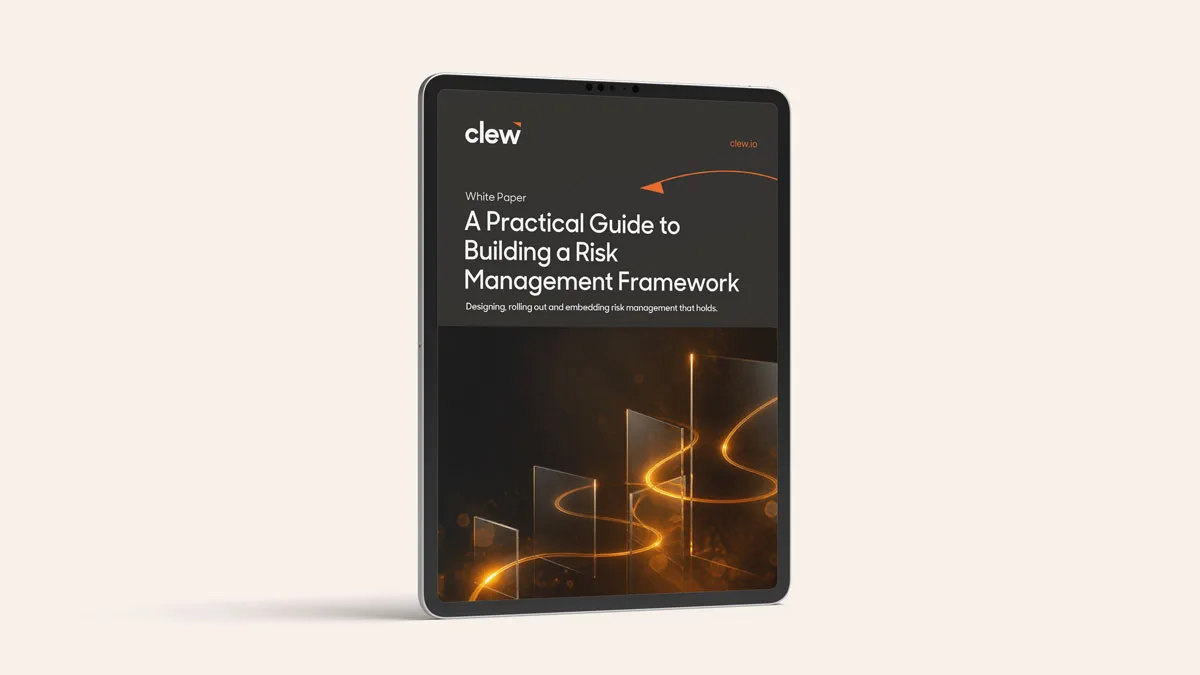
Most organisations already have a risk management framework. There is a policy document, a risk register, and a reporting cycle that runs on schedule. What tends to be missing is the operational connection that turns those artefacts into a working system, one where a named person owns every material risk, appetite genuinely shapes decisions, and reporting drives action rather than describing it after the event. This white paper looks at why that gap opens and how to close it.
Why risk management frameworks fail after approval
A framework rarely fails on the day it is signed off. It fails quietly over the following eighteen months, in ways that each look forgivable but together strip the framework of its usefulness. The paper sets out the recurring patterns behind that slow decline, from the framework that behaves like a filed policy document to the risk register that grows so large everything looks important and nothing is prioritised. Recognising these patterns early is the first step to avoiding them.
The six decisions behind a working risk management framework
Choosing a standard is where the work starts, not where it ends. Whether an organisation adopts ISO 31000, COSO, or a blend of both, the same set of decisions determines whether the framework is actually used. This practical risk management guide frames those decisions around purpose, ownership, appetite, assessment, reporting rhythm and assurance, and explains what good looks like for each one alongside the failure mode that quietly undermines it. Getting these decisions right is what separates a framework people use from one they simply file.
Making ownership and appetite real
Two decisions tend to separate a framework that informs behaviour from one that sits on a shelf.
Named ownership that holds
The first decision is ownership. Assign a risk to a committee and you have assigned it to nobody, so the paper examines what genuine named accountability requires and how to tell whether an owner can actually act on the risk in front of them.
Appetite that changes decisions
The second is appetite. Many organisations can produce an appetite statement on request, yet far fewer can point to a decision it changed. The guide explores how to turn appetite into something that surfaces at the moment a real approval, procurement or investment decision is made.
Embedding the framework into existing business rhythm
A rollout that creates a parallel set of meetings competes with the rhythm an organisation already has, and it usually loses. The paper describes how to weave risk into planning, performance reviews, project governance and board reporting so the framework becomes part of existing cycles rather than an additional burden. It also introduces four working tools, including a design canvas, a ninety day rollout plan and a readiness checklist, built for immediate use. Embedding risk this way keeps the framework close to the moments where decisions are actually made.
Who This White Paper Is For
This guide is written for the people responsible for risk actually working in practice. Chief risk officers and heads of risk will find a concrete method for designing and sustaining a framework that survives contact with a live organisation. Operational and business unit leaders will see how ownership and appetite affect the decisions they make every week, while executives and board members gain the language to test whether their current framework is doing its job.
A framework that looked solid at launch can drift into irrelevance within a year if nothing sustains it. The disciplines that keep it alive matter as much as the design itself, and they are often the hardest to see until something goes wrong. If you want a clear, tested approach to building a risk management framework that holds under real pressure, this practical guide gives you the method and the tools to do it. Download the white paper to read the full argument.