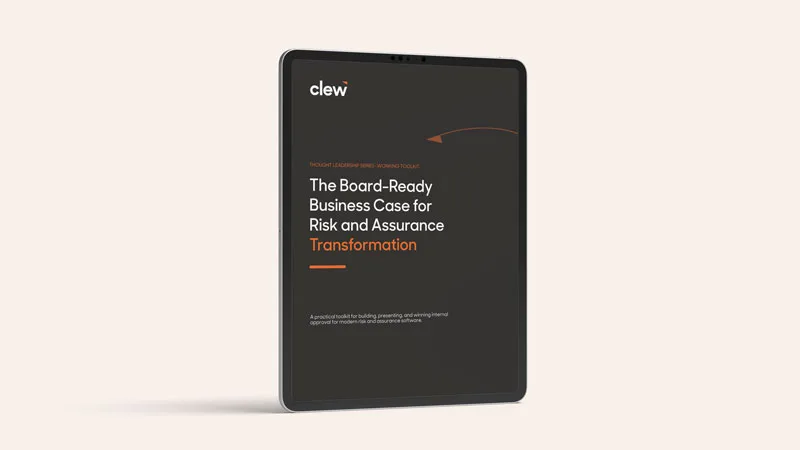
Most internal proposals for risk and assurance software never make it past the finance team. The technology is sound and the need is real, yet the request stalls or gets quietly deprioritised. The reason is rarely the investment itself. It is that the case is written in risk language for an audience that thinks in cost, return and confidence. This board ready business case for risk software gives risk leaders a structured method to build, present and win internal approval for a modern platform, using the evidence a CFO or CEO actually responds to.
Why most business cases for risk software fail
The patterns of failure are consistent. Proposals lead with features rather than outcomes. They lean on compliance as the main justification, which finance hears as a cost of doing business rather than a strategic investment. They rarely quantify what the current state is already costing the organisation, and they often arrive framed as an IT project, which triggers a slower approval path and a different set of questions. The result is a document that is technically accurate and completely unconvincing. This business case flips the order, moving from cost to risk to return to confidence, so the argument reaches the board the way it expects to receive it.
The four pillars of a board ready business case for risk software
Every proposal that succeeds with a CFO answers four questions in sequence. What is the current state costing us now. What happens if we do nothing. What does better look like and what does it return. And can we actually deliver it. The business case works through each one in turn, with worksheets and prompts that turn vague concern into figures you can defend under questioning.
Costing the current state and the risk of inaction
The first pillars establish that there is a problem worth solving. Much of what the current approach costs stays invisible, buried in staff time, duplicated effort and decisions made without adequate visibility. The business case shows how to surface those hidden figures, then how to build inaction scenarios that quantify what the organisation stands to lose. This is frequently the most persuasive part of any submission, and it is almost always underused.
Modelling return and proving you can deliver
The later pillars make the affirmative case. What specifically changes, what it returns, and why the organisation can be confident in the rollout. The business case explores how to model return in a way boards trust, why conservative numbers win the room, and how a phased approach with early proof of value keeps execution risk low. It also looks at time to first value, the number a board audience tends to weigh most heavily.
From evidence to a single decision page
Board decisions often turn on one page. The business case includes a one page executive summary template that pulls every figure from the pillars into the document the CFO actually reads, supported by a set of working appendices. Inside you will find an ROI calculation worksheet, an objection handling cheat sheet for the six challenges you are most likely to meet, and a five slide board presentation outline you can adapt directly. A set of reference benchmarks helps you sense check your own numbers before they go upstairs.
Who This Business Case Is For
This toolkit is built for risk and assurance leaders, heads of governance, and the internal champions who need to secure budget for a modern platform. Chief risk officers and risk managers gain a defensible structure and the language to reach a finance audience. Anyone preparing for a board or committee will find ready to use templates that turn scattered evidence into a single clear recommendation.
Budget cycles reward the proposals that are ready when the window opens. A board ready business case for risk software is the difference between a request that stalls and one that gets approved on its merits. Download the business case to build yours.