


Residual risk is what you are actually carrying. Inherent risk is the exposure before controls; residual risk is what is left with controls working as they really do.
Do not calculate it by subtraction. Rate the risk again from evidence of how each control performs, and record why.
A residual rating only matters against appetite. It tells you whether to accept the risk, treat it further or escalate it.
The risk manager at a regional water company sorted the register by the gap between its inherent and residual ratings. Sixty-one of the 64 risks sat exactly one band lower after controls. Extreme had become high, high had become medium and medium had become low, almost without exception.
That is not 61 separate judgements. It is a habit. Somewhere along the way, residual risk had become the inherent rating minus one, and the board had been reading it as evidence that the controls worked.
This guide covers what residual risk means, how it differs from inherent risk, why it should not be calculated by subtraction, and how to rate it from evidence instead, with a worked example and what to do when the rating sits above appetite.
What Is Residual Risk?
Residual risk is the risk that remains after controls are taken into account, rated on the controls as they actually perform rather than as they were designed to. It is expressed like any other risk rating, as a likelihood and a consequence, and it is the rating an organisation compares with its risk appetite to decide whether a risk is acceptable.
In plain terms, it is what you are actually carrying. The rest of this guide is about making sure that rating is honest.
Inherent Risk vs Residual Risk
Inherent risk is the same risk rated before controls: the exposure the organisation would face if nothing were in place to prevent it or limit its effects. Residual risk is the exposure that remains with today’s controls working as assessed.
| Inherent risk | Residual risk | |
|---|---|---|
| What it measures | The exposure before controls | The exposure with controls as they actually perform |
| The question it answers | How badly could this hurt us if nothing stood in the way? | How exposed are we now, with what we actually have in place? |
| What drives it | The nature of the activity, the hazard and the environment | The inherent exposure and the evidence on each control |
| When it changes | When the activity, the hazard or the environment changes | Whenever a control is tested, fails, degrades or is improved |
| Water utility example | Loss of supply from a treatment works: likely and major, rated extreme | The same risk with its four controls as tested: possible and major, rated high |
The gap between the two ratings is what the organisation’s controls are worth. If the gap is the same for every risk, it is probably not being measured.
Key distinction: inherent vs residual
Inherent risk asks what could happen without controls. The residual rating asks what can happen with the controls you actually have, working as well as they actually work.
How to Calculate Residual Risk, and Why Not by Subtraction
Many guides give a formula: residual risk equals inherent risk minus the impact of controls. It is tidy, and it causes three problems.
- Ratings are judgements on ordinal scales, not measurements, so a “high” is not a number you can subtract from. The limits of arithmetic on matrix ratings are covered in our risk matrix guide.
- Subtraction counts controls as intended, not as assessed. A control that exists on paper reduces the score whether or not anyone has checked that it works.
- One blanket reduction hides the weak control. If four controls together earn “one band lower”, nobody can see which one the rating depends on, or what happens when it fails.
Australia’s Comcover makes a related point in its guidance on control effectiveness: control ratings picked on a best guess are usually inaccurate and open to bias, and a risk that has not happened is no proof its controls are working. A residual rating built on those control ratings inherits the same problems.
The residual rating is not the inherent rating minus a number. It is the same risk, rated again, on the evidence.
How to Rate Residual Risk in Five Steps
1. Start from the inherent rating
Rate the risk on your organisation’s matrix as if no controls were in place, using the same likelihood and consequence scales you use everywhere else. Record why.
2. List the controls the rating depends on
Name each control that acts on the risk, and say whether it reduces likelihood, consequence or both. If you cannot name the control a rating depends on, the rating is not ready.
3. Take each control’s assessed effectiveness
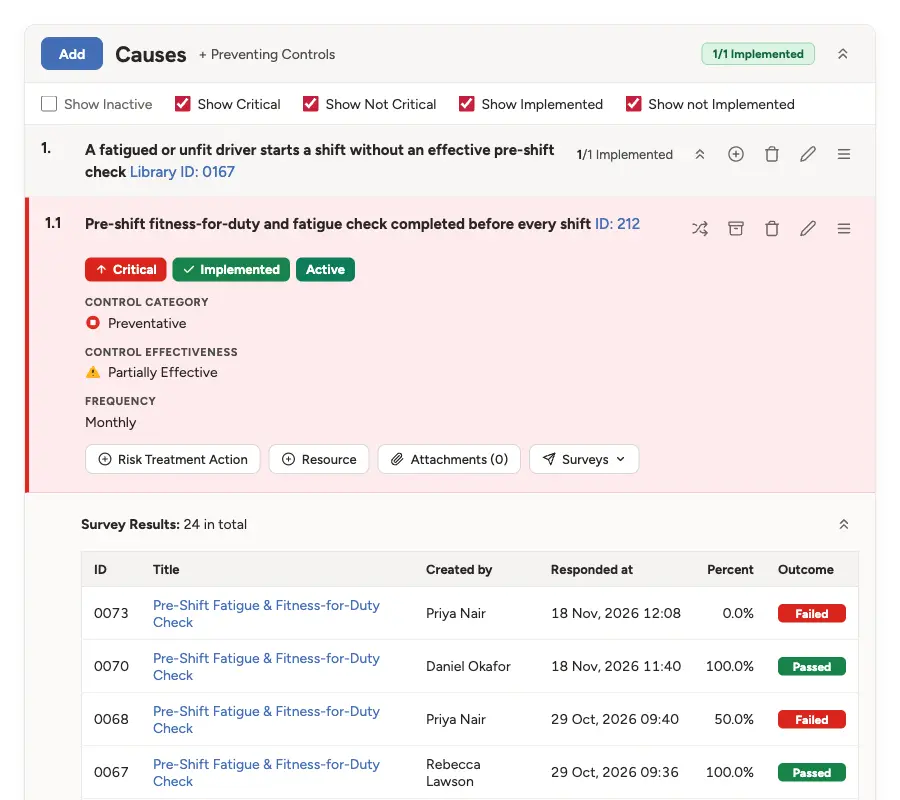
Use the result of the last test, not the control owner’s view: effective, partially effective, ineffective or untested. An untested control should not reduce the rating at all. How to test a control’s design and operation is set out in how to assess control effectiveness.
4. Re-rate likelihood and consequence
Ask how likely the risk is now, and how severe it would be, with each control working only as well as its evidence shows. Re-rate the two separately: a control that cuts likelihood leaves consequence untouched, and the residual rating should show it.
The UK Civil Aviation Authority’s bowtie guidance offers a useful test here. It treats a control’s effectiveness as its adequacy multiplied by its reliability, so a strong control that is applied half the time is a weak control in practice.
5. Record the reasoning
Write a sentence or two beside the residual rating: which controls it relies on, what their evidence says, and what would move it. That sentence is what the audit committee will ask for, and what the next reviewer needs.
Residual Risk Example
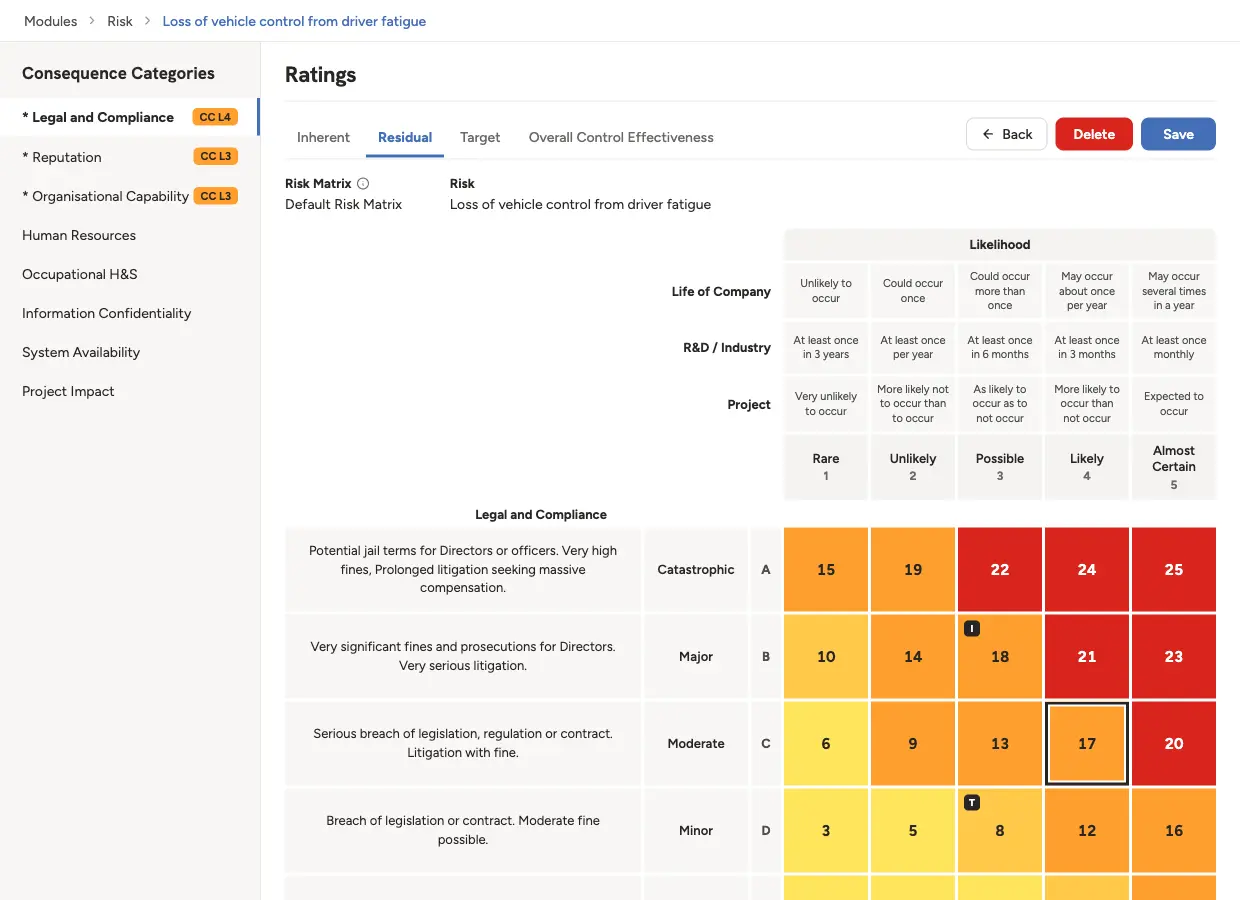
Here is the method applied to one risk at a UK water utility: loss of supply from a treatment works serving a large town. It is rated on the 5×5 matrix in our risk matrix guide.
The inherent rating is likely and major, which is extreme. Without controls, one equipment failure or power cut could stop treatment, and a prolonged outage would leave thousands of homes without water.
| Control | What it acts on | Latest evidence | Effectiveness |
|---|---|---|---|
| Duplicate treatment stream | Likelihood of total loss | Switchover tested twice this year, both times successfully | Effective |
| Standby generator | Likelihood of loss during a power cut | Starts every week, but has never run the works under full load | Partially effective |
| Interconnect with a neighbouring works | Consequence, for up to 24 hours | Exercised in March, when supply held for 26 hours | Effective |
| Planned maintenance programme | Likelihood of equipment failure | 14% of critical tasks overdue | Partially effective |
Subtraction would count four controls and drop the rating two bands, from extreme to medium. The evidence says otherwise. The generator has never carried the works, and the maintenance backlog raises the chance of the very failure the duplicate stream is meant to absorb. Likelihood falls from likely to possible. Consequence stays major, because beyond 24 hours the interconnect runs out. Possible and major is high.
The note beside the rating reads: high, relying on the duplicate stream and the interconnect; it would move to medium once the generator passes a full-load test and the overdue maintenance falls below 5%.
Residual Risk and Risk Appetite: Accept, Treat or Escalate
A residual rating means little on its own. Its job is to be compared with the organisation’s tolerance for that kind of risk, and to trigger one of three decisions.
- Accept the risk when the residual rating sits inside tolerance, and record who accepted it and when it will next be reviewed.
- Treat the risk when the residual rating sits above tolerance and something can be done, with an action, an owner, a date and a target rating.
- Escalate the risk when the residual rating sits above tolerance and the owner lacks the authority or resources to bring it back.
In the example, the utility has a low appetite for loss of supply, so a high residual rating sits above it. The risk is treated: a full-load generator test this quarter and a plan to clear the maintenance backlog. Once both are done, an outage would be shorter, bringing the consequence to moderate and the target rating to medium. How to set those tolerances is covered in how to write a risk appetite statement.
Who accepts the risk matters as much as the rating. Acceptance should sit with someone whose authority matches it: a manager for a low risk, an executive for a high one, and the board for anything outside appetite.
Keeping all of this current in a spreadsheet is hard. Control evidence lives in one place, ratings in another and the reasoning nowhere. Purpose-built risk management software keeps each rating linked to the controls and evidence behind it, with board-level reports drawn from the same data.
Target Risk: Where the Rating Should End Up
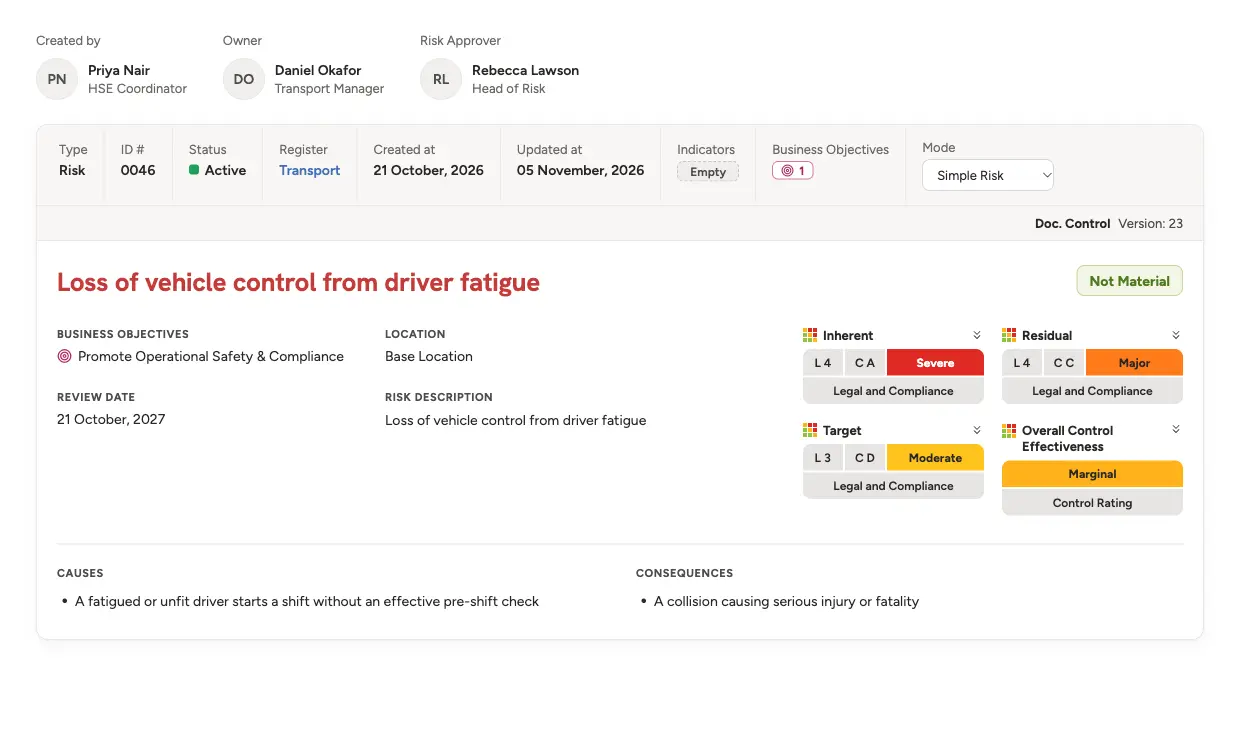
A third rating completes the picture. Target risk is the rating you intend a risk to reach once the planned actions are complete. Recording inherent, residual and target side by side shows three things at a glance: what the risk could be, what it is now, and what the organisation is working towards.
- The target must sit inside tolerance, or the plan is not finished.
- Each target needs a date and the actions that will get it there, each with an owner.
- Planned controls count towards the target, never towards the residual rating, until they are in place and tested.
In the example, the target is medium (possible and moderate), to be reached once the generator passes its full-load test and the maintenance backlog is cleared. The gap between residual and target is the work still to do, and it is the gap the board should be watching.
Common Residual Risk Mistakes
- Every residual rating sits one band below inherent. That is a habit, not an assessment, and it tells the board nothing about which controls matter.
- Untested controls count as effective. A control nobody has checked should not reduce a rating until the evidence exists.
- Consequence falls because of controls that only act on likelihood. Rate the two separately, so each control moves only what it acts on.
- Ratings are never revisited. Re-rate when a control is tested, fails or changes, and when an indicator moves, as described in key risk indicators.
- No reasoning is recorded. A rating without a sentence behind it cannot be challenged, and it cannot be defended.
Get the residual rating right and it becomes the most useful judgement in the register. It is the point where the traceable link from an organisation’s objectives through its risks, controls, actions and assurance to the indicators that show whether it is performing is tested against reality.
Frequently Asked Questions
What is residual risk?
Residual risk is the risk that remains after controls are taken into account, rated on how those controls actually perform. It is the rating an organisation compares with its risk appetite to decide whether a risk is acceptable.
What is the difference between inherent risk and residual risk?
Inherent risk is the exposure before any controls. Residual risk is the exposure with today’s controls working as well as the evidence says they do. The gap between the two is what the controls are worth.
How do you calculate residual risk?
Do not subtract a control score from the inherent rating. Re-rate likelihood and consequence with each control working as well as its latest evidence shows, on the same matrix you used for inherent risk, and record the reasoning.
What should you do if a risk is still above appetite after controls?
Treat it, with an action, an owner, a date and a target rating, or escalate it to someone with the authority and resources to act. Accepting a risk above appetite should be a deliberate, recorded decision by the right person, not a default.
Who can accept residual risk?
Someone whose authority matches the rating. Many organisations let managers accept low risks, require an executive for high risks, and take anything outside appetite to the board or its risk committee.
Put your ratings on evidence. Clew is a risk and assurance platform built around the Golden Thread, so every residual rating connects to the controls it relies on, the evidence behind them and the indicators that show when it is moving. Risk and assurance teams in government, healthcare, construction, infrastructure and utilities, mining and resources, and transport use Clew to keep their risks, controls and indicators connected to the objectives they protect. See how that works in practice: watch the on-demand Clew walkthrough, or explore Clew’s risk management software.
Related Resources
- How to assess control effectiveness covers the evidence behind every residual rating.
- How to use a 5×5 risk matrix explains the scale both ratings use.
- How to write a risk appetite statement sets the tolerances each residual rating is compared against.
- How to build a risk register shows where both ratings are recorded.
- Bowtie analysis maps the barriers that hold a risk back.